
Cædmon was a cowherd, who turned poet and saintly monk in 7th century Northumbria. Find the literature here
We get the story from Bede’s Ecclesiastical History of England. He tells how the illiterate herdsman at Whitby Abbey woke up one morning with his head filled with a beautiful poem in Old English venerating the Lord God as creator and guardian. While Bede rendered the poem in a Latin translation, the Old English version was soon added to his rand work. Today, the hymn is known from at least 23 manuscripts of which the oldest surviving copy dates to ca. 737. Apart from Bede’s Latin translation it is preserved in five distinct recensions and two Northumbrian dialects.
Continous debate has raged about the status of the poem. Was it a back-translation of Bede’s Latin text, or was it indeed a more or less faithful transmission of Cædmon’s original? And who was Cædmon, if not a figment of Bede’s mind?
There are three recent books which gives us the best modern introductions to the text, its many variants, the philology and the history behind.
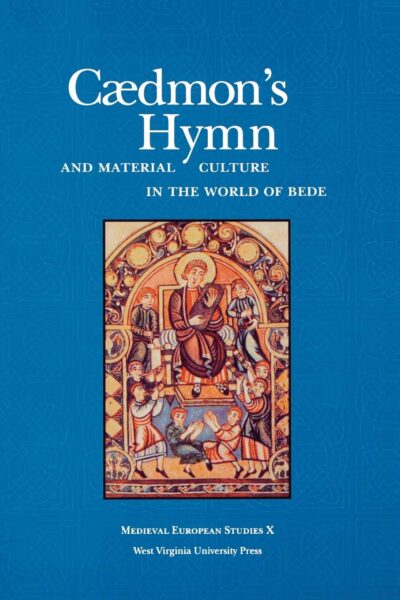 Caedmon’s Hymn and Material Culture in the World of Bede
by Allen J. Frantzen and John Hines
West Virginia University Press 2007
ABSTRACT:
The essays in this book use the nine-line poem known as Cædmon’s Hymn as a lens on the world of Bede’s Ecclesiastical History. A cowherd who is given a divine gift, Cædmon retells the great narratives of Christian history in the traditional form of Anglo-Saxon verse. An immense amount has been written about this episode, much of it concentrating on the hymn’s significance in the history of English literature. Relatively little attention, however, has been paid to what the story of Cædmon and his hymn might tell us about the material, as well as the textual, culture of Bede’s world. The essays in this collection seek to connect Cædmon’s Hymn to Bede’s material world in various ways. Each chapter begins with the hymn and moves from the text to the worlds of scientific thought, settlements and social hierarchy, monastic reform, and ordinary things. The connections explored here are a sampling of the material concerns Cædmon’s Hymn raises.
 Cædmon’s Hymn: A Multi-media Study, Edition and Archive
by Daniel Paul O’Donnell
D.S. Brewer 2005
Electronic edition 2018
ABSTRACT:
Caedmon’s Hymn is a central poem in many crucial debates in Anglo-Saxon studies. It is the earliest attested Old English verse text, our best-documented example of ostensibly oral composition, and the only surviving poem for which a contemporary record exists of its reception. The most textually complex poem in the corpus, the Hymn long has served as an important test case for textual scholars. This book is an essential resource for students of Caedmon’s Hymn. It provides the first comprehensive literary and historical re-examination of the poem in over thirty years and the first complete textual study and edition in nearly seventy. The book radically revises our understanding of the Hymn’s transmission and challenges assumptions about its place in Anglo-Saxon poetic history. It offers new critical texts and a textual archive with transcriptions and facsimiles of all medieval witnesses. The edition is also a milestone in the integration of digital and print scholarship. A print volume, designed for ready reference, contains the complete introductory study and essential versions of the critical and diplomatic texts; the accompanying CD-ROM, intended for closer research, supplements the text of the print volume with colour digital facsimiles and interactive tools only possible in the electronic medium. Dr Daniel Paul O’Donnell (University of Lethbridge) has written widely on the transmission and reception of medieval vernacular literature and humanities computing. He is the founding director of the Digital Medievalist Project
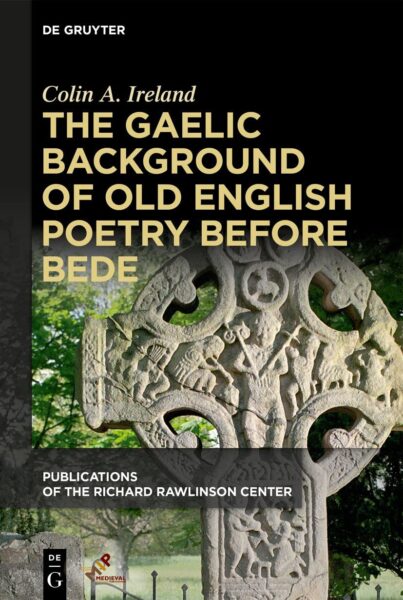 The Gaelic Background of Old English Poetry before Bede
By Colin A. Ireland
Part of: Publications of the Richard Rawlinson Center
DeGruyter 2025
Seventh-century Gaelic law-tracts delineate professional poets (filid) who earned high social status through formal training. These poets cooperated with the Church to create an innovative bilingual intellectual culture in Old Gaelic and Latin. Bede described Anglo-Saxon students who availed themselves of free education in Ireland at this culturally dynamic time. Gaelic scholars called sapientes (“wise ones”) produced texts in Old Gaelic and Latin that demonstrate how Anglo-Saxon students were influenced by contact with Gaelic ecclesiastical and secular scholarship. Seventh-century Northumbria was ruled for over 50 years by Gaelic-speaking kings who could access Gaelic traditions. Gaelic literary traditions provide the closest analogues for Bede’s description of Cædmon’s production of Old English poetry. This ground-breaking study displays the transformations created by the growth of vernacular literatures and bilingual intellectual cultures. Gaelic missionaries and educational opportunities helped shape the Northumbrian “Golden Age”, its manuscripts, hagiography, and writings of Aldhelm and Bede.
PHOTO:
Chillingham Cattle. Source: Divulgação/Open Source
READ MORE: