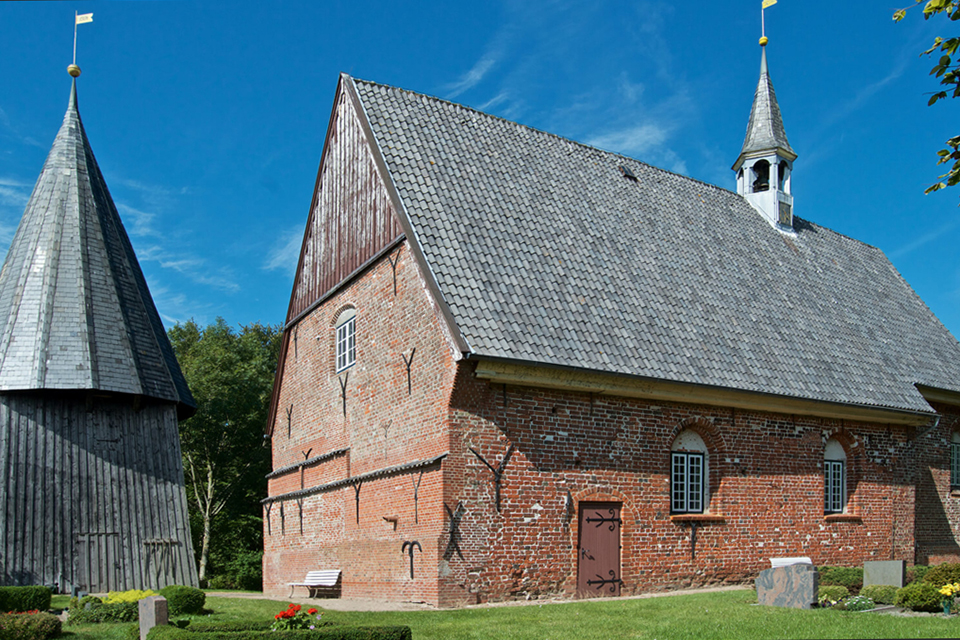
The medieval town of Rungholt drowned in a storm surge in 1362. Today, it lies submerged in shallow waters outside the Westcoast of Northern Germany. Recent surveys have led to the location of the large and impressive church, which was swept aside in the storm.
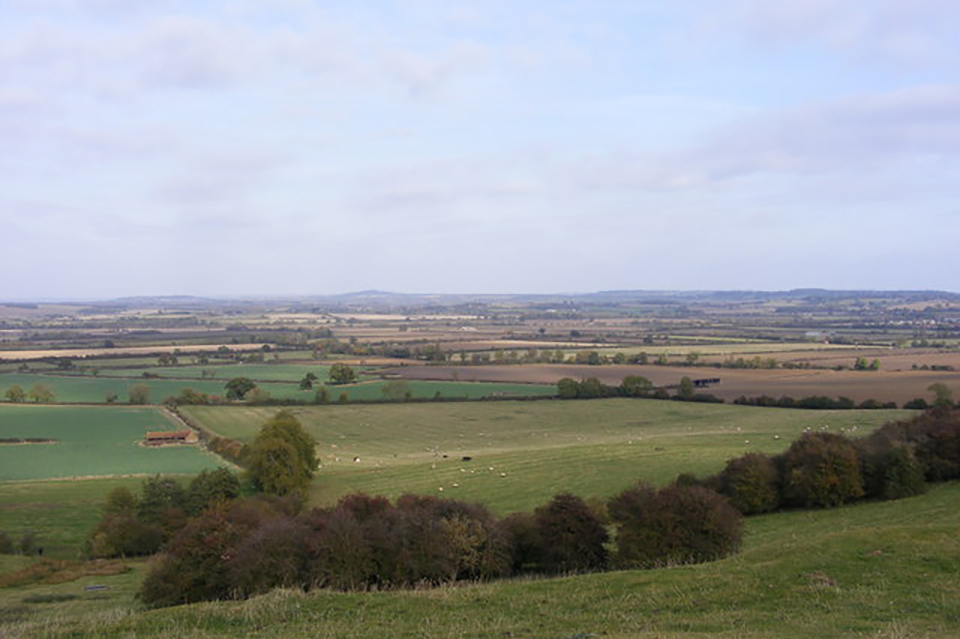
In the 13th century, Chipping Dassett became the site of a flourishing market town. After the plague, the market declined, and at the end of the 15th century, the place was deserted.
This Whitsun, Södra Råda Church in Värmland in Sweden will be re-inaugurated. The aim of the reconstruction of the burnt-down medieval treasure was to learn how a church was built in the 14th century.
In 1358, the village of Venette near Compiegne was visited by marauding English troops burning, pillaging and murdering innocent people. These events inspired an evocative and haunting description of the horrors of wars
In the years from c. 1359 – 1368, a Carmelite friar and head of the order’s French province wrote a profoundly moving chronicle about the events in France since 1340, the devastation of the plague and the atrocities waged by armies and bands of mercenaries on Northern France. Scholars have postulated that the event, which prompted him to write, was the wholesale destruction of the village, Venette, along the river Oise, where he was born. He writes:
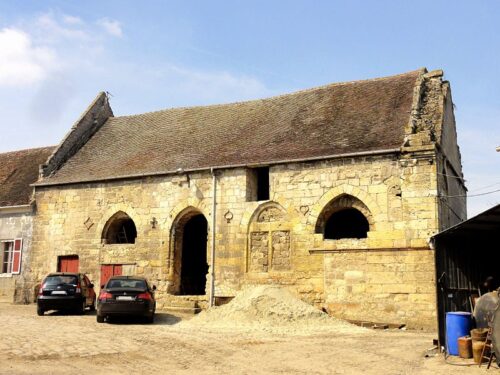
The old Batimént Conventuelle at Venette. Perhaps the harassed people hid there – and were murdered in 1358. Source: wikipedia
“The English destroyed, burned, and plundered many little towns and villages in this part of the diocese of Beauvais, capturing and even killing the inhabitants. The loss by fire of the village where I was born, Vennette near Compiègne, is to be lamented together with that of many others nearby. The vines in this region, which supply that most pleasant and desirable liquor which make glad the heart of man, were not pruned or kept from rotting by the labors of men’s hands. The fields were not sown or ploughed. There were no cattle or fowl in the fields.
No cock crowed in the depths of the night to tell the hours. No hen called to her chicks. It was of no use for the kite to lie in wait for chickens in- March of this year nor for children to hunt for eggs in secret hiding places. No lambs or calves bleated after their mothers in this region. The wolf might seek its prey elsewhere and here fill his capacious gullet with green grass instead of rams. At this time rabbits and hares played freely about in the deserted fields with no fear of hunting dogs, for no one dared go coursing through the pleasant woods and fields. Larks soared safely through the air and lifted their unending songs with no thought of the whistling attacks of eyas or falcon. No wayfarers went along the roads, carrying their best cheese and dairy produce to market. Throughout the parishes and villages, alas! went forth no mendicants to hear confessions and to preach in Lent but rather robbers and thieves to carry off openly whatever they could find.
Houses and churches no longer presented a smiling appearance with newly repaired roofs but rather the lamentable spectacle of scattered, smoking ruins to which they had been reduced by devouring flames. The eye of man was no longer rejoiced by the accustomed sight of green pastures and fields charmingly colored by the growing grain, but rather saddened by the looks of the nettles and thistles springing up on every side. The pleasant sound of bells was heard indeed, not as a summons ·to- divine worship, but as a warning of hostile incursions, in order that men might seek out hiding places while the enemy were yet on the way. What more can I say? Every misery increased on every hand, especially among the rural population, the peasants, for their lords bore hard upon them, extorting from them all their substance and poor means of livelihood. Though there were few flocks or herds, those who owned any were forced to pay their 51 lords for each animal; 10 solidi for an ox, 4 or 5 for a sheep. Yet, their lords did not, in return, repel their enemies or attempt to attack them, except occasionally”
From: Jean de Vennette: The Chronicle. Translated by Jean Birdsall. Edited. With an introduction and Notes, by Richard A. Newhall. Columbia University Press 1953, s. 93 – 94
St. Martin at Venette
The village was repeatedly destroyed, first by the Norman Vikings in the 10th century, again in 1358 – as described above – and finally in 1430. The latest fighting took place during the Napoleonic wars.
Situated two kilometres from the Abbey of Saint-Corneille de Compiègne, which was founded in AD 876, the history of the village history will have been intimately entwined with this. Exactly, though, when the village was founded is not known. Currently, the village is included in the town of Venette, which grew up around the Abbey. Most of the village dates to the 19th century.
The church, which dates to the 12th century, does feature a few details from the time of Jean de Venette, primarily the ribbed vaults in the choir. But, apart from these, the mix and match of styles in the church’s fabric witness to the constant effort to keep it under a roof.
More interesting is the 13th century conventual building – the Bâtiment Conventuel – in the courtyard of the old seignorial farm at Rue de Corbeaulieu. Perhaps the frightened people of Venette sought refuge here?
The village is worth a drive-through just to pay tribute to one of the great chroniclers of the 14th century, Jean de Venette.
Jean de Venette
Of peasant origin, Jean joined the Carmelite order and was elected prior of the Carmelite convent at Paris in 1339. In 1342 he was appointed provincial of France. Probably, he also taught theology at the University of Paris, where he experienced the horrors of the Black Death.
His Latin chronicle, covering the period of 1340–68, was a continuation of an earlier chronicle by Guillaume de Nangis. Although he was interested in the fate of the ruling Valois dynasty, he displayed an marked sympathy for the peasants and was critical of the leaders of France. Unique among chroniclers at that time, he wrote as an eyewitness offering distinct characetisations of the events he recorded. He also wrote an unpublished religious poem, the Roman des trois Maries (c. 1347).
EDITIONS:
Jean de Vennette: The Chronicle.
Translated by Jean Birdsall.
Edited with an introduction and notes, by Richard A. Newhall.
Columbia University Press 1953
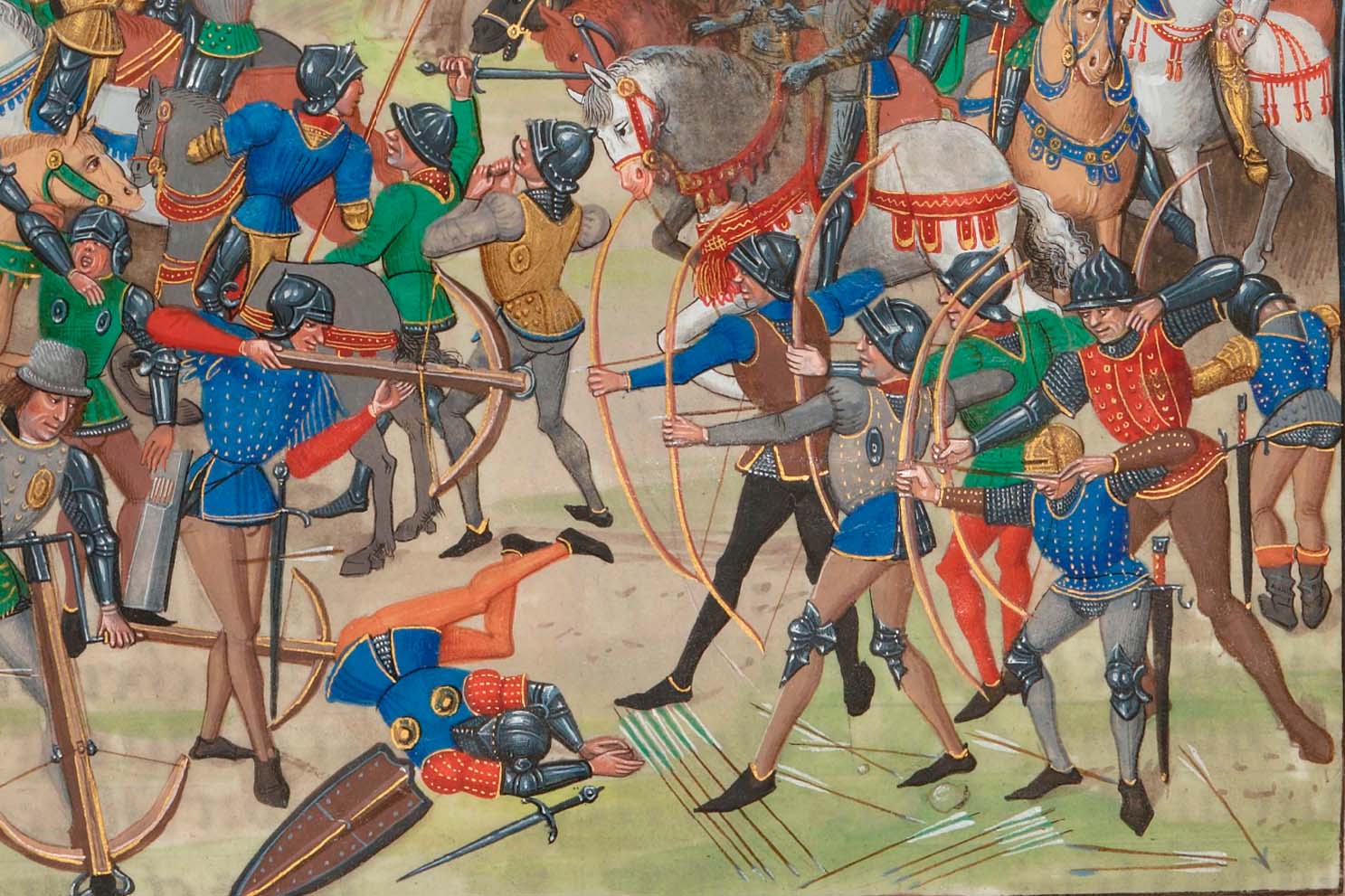
In 1346 Edward III launched an invasion of Medieval France. Mounting the largest medieval invasion ever, he gained an overwhelming victory of the French army at Crécy. Since then, scholars have asked whether he was just lucky or a superb strategist.
In recent political and constitutional history, scholars seldom specify how and why they use the concept of territory. New book argues that territory is the lived space of people
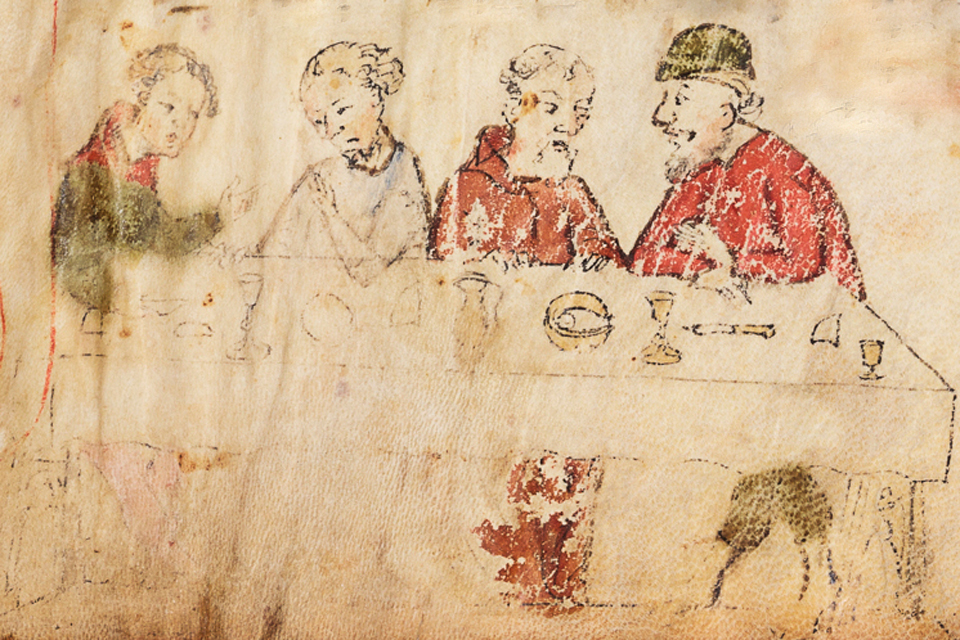
The Lombard Haggadah has been preserved in a private collection for more than hundred years. Recently put up for sale, there is this upcoming week a unique possibility for New Yorkers to enjoy the Gothic manuscript.
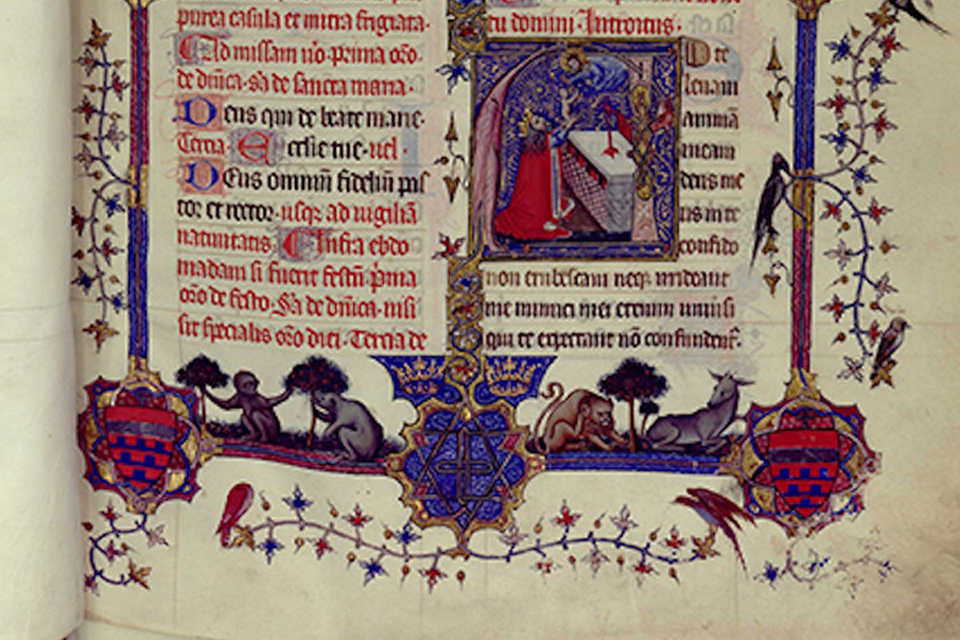
The Missal of Roselli – Messale Roselli – was produced for Cardinal Nicolas Rosell in Avignon c. 1350. Now, in Torino, it represents one of the beautiful illuminated missals from the 14th century.
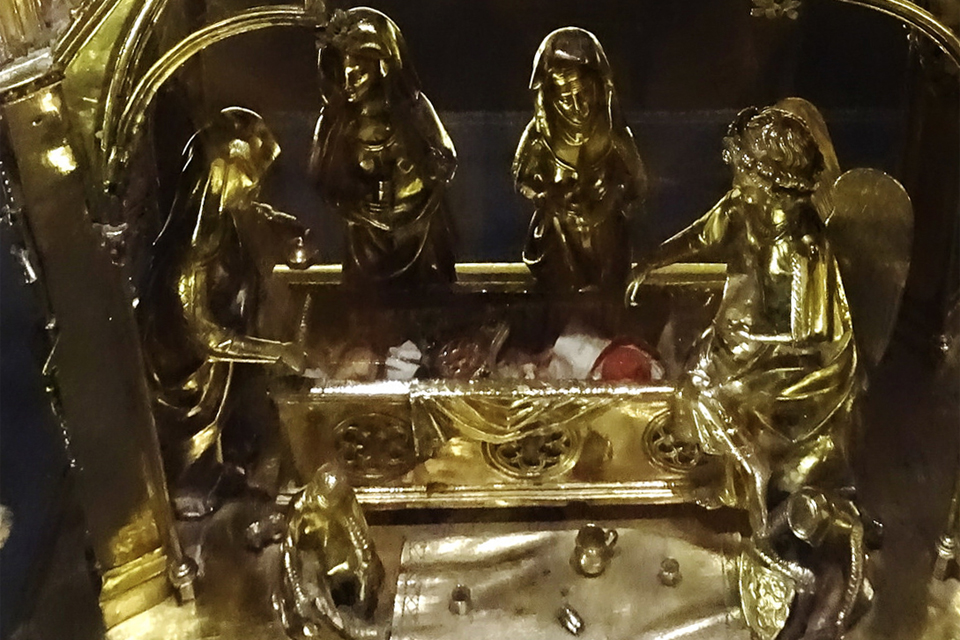
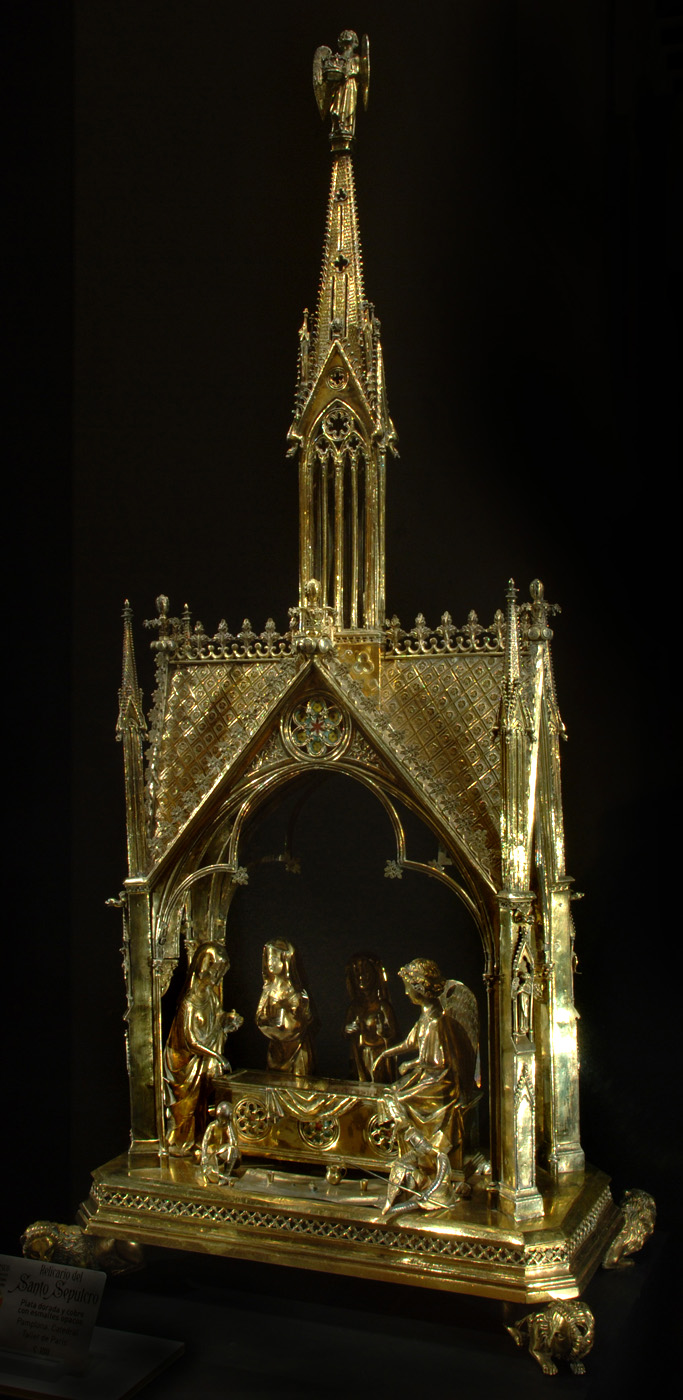
In 1993, the contents of the reliquary of the Holy Sepulchre in Pamplona were carefully explored. The following documentation shows that the reliquary is not only unique as a piece of art. It had been fitted with precious and “authentic” relics related to the “empty” tomb.
The reliquary of the Holy Sepulchre in Pamplona belongs together with the Lignum Crucis, to the former royal collection of the crown of Navarre. The reliquary from c. 1255 (1300) takes the form of an open aedicule raised on an oblong platform. It belongs to the arthistorical cathegory: Gothic micro-architecture. Buttresses, topped by pinnacles and cusped arches, flank the four open sides, while the windows are decorated with champlevé enamel. This decorative element may also be found on the sarcophagus in the middle of the tableau, which shows the dramatic scene with the sleeping soldiers, the angel claiming, “he is not here”, and the holy women staring down in horror into the empty grave filled with the sudario, the holy shroud, which John writes, was carefully folded and laid to the side.
And he saw the linen wrappings lying there, and the cloth that had been on Jesus’ head, not lying with the linen wrappings but rolled up in a place by itself. (John 20: 6 – 7).
Apart from the fact that the tableau represents an amalgamation of the “Empty Grave Scenes” from Mark and John, it ads an extra layer. The sarcophagus is fitted with a lid made of rock crystal, through which we together with the holy women may glimpse a gold capsule with what we are told is a fragment of the original sudario – DE SUDARIO DOMINI, we read. We don’t just see the scene, we are carefully invited into the grave participating in the horror and the adoration.
The Pamplona reliquary thus represents a new type of reliquaries, which do not enshrine the holy relics, but rather open them up to let us participate. We become more than just spectators. We get enrolled in the scene with the gesturing figurines replaying inside a temporal sequence the emotional eruption, which the biblical verses only hint at … for terror and amazement had seized them, writes Mark (Mark 16:8).
The Contents of the Reliquary
The reliquary of the Holy Sepulchre from Pamplona. Source: Wikipedia
In 1993 the reliquary was opened in order to register and study the contents. Inside the tiny sarcophagus, three small capsules were found.
The first, a small flat capsule decorated with Gothic openwork, was inscribed with + De Sudario Domino. The second was inscribed with + de Sepulcro Domino, while the last was inscribed with + DE MENSA CENE DOMINI. While the first contained a piece of red linen, the second a small piece of a rock wrapped in linen, while the third contained small pieces of stones. Further the sarcophagus contained a piece of white silk, a piece of linen, fragments of wood, a pebble, a lock of blond hair, small pieces of stained glass, and some red linen wrapping pieces of wood. Also included was a written list explaining the importance of the stones and fragments, all derived from the life and passion of the Lord. These lists are written in a hand form the 16thcentury.
Unfortunately, the exploration of the contents of the sarcophagus did not lead to a camparison of the textile fragments with the alleged Sudario kept in the Cathedral in Orviedo. It would have been nice to know if the tiny fragment had been cut off from that and afterwards placed in its capsule in Pamploma.
The reliquary has traditionally been considered a wedding gift from St. Louis, King of France, to his daughter Isabel in 1255, when she married Theobald II of Navarrea Recently, though, it has been proposed that the reliquary dates from 1284, when Phillipe (a grandson of St. Louis) married Juana de Navarra. The reliquary may have been created as a reflection of the architecture of the Sainte-Chapelle in Paris (1248); as perhaps is also the case with the reliquary of St. Louis, which was donated to St. Domenico in Bologna c. 1300. To a large extent, the two reliquaries may be seen to mirror the same artistic ambition and taste.