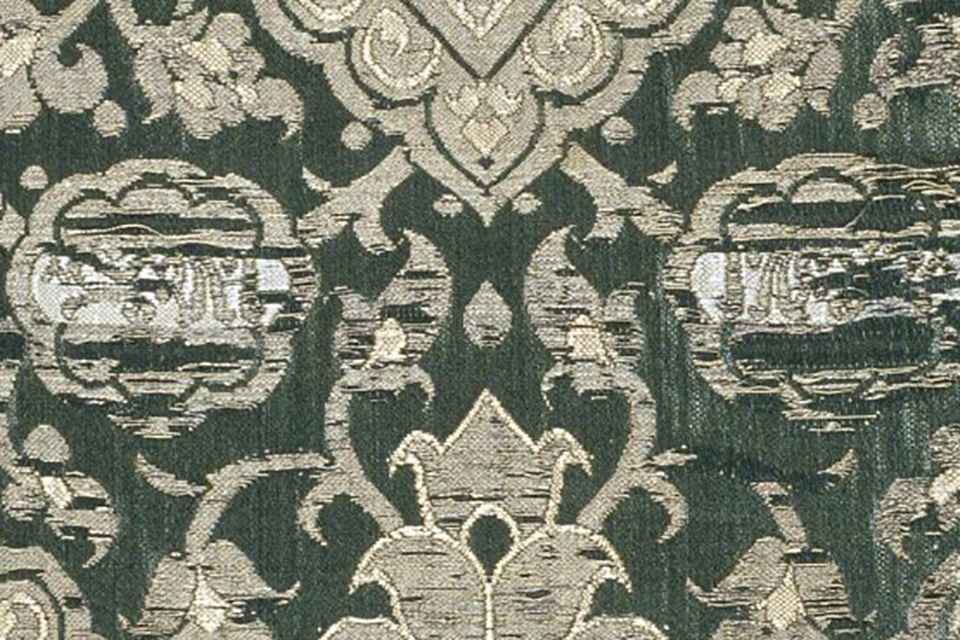
In the Late Middle Ages “Syriana”, luxury products from Syria and Egypt, were immensely desired. One such artefact is preserved in The Victoria & Albert Museum
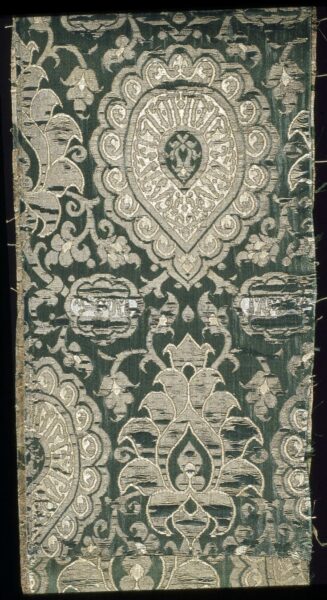
In the Victoria & Albert Museum, a long rectangular strip of silk tapestry from the 15th century, decorated with tall palmettes, lobed pear-shaped medallions with inscriptions in their borders, and lobed cartouches containing shorter, horizontal inscriptions.
This strip of silk was used as the orphrey of an ecclesiastical vestment, and is of a type of Mamluk textiles which was very popular in Europe in the later medieval period. They must have been imported from the eastern Mediterranean.
The pear-shaped medallions are inscribed with the phrase ‘ ‘izz li-mawlana al-malik’, meaning ‘glory to our lord the king’. The smaller medallions, which have eight lobes, are inscribed with the word ‘al-Ashraf’ (meaning ‘Exalted’). This was one of the titles used by Sultan Qa’itbay (1468-1496), but that does not necessarily mean that this textile was therefore made during that Sultan’s reign.
Short history of Mamluk silks
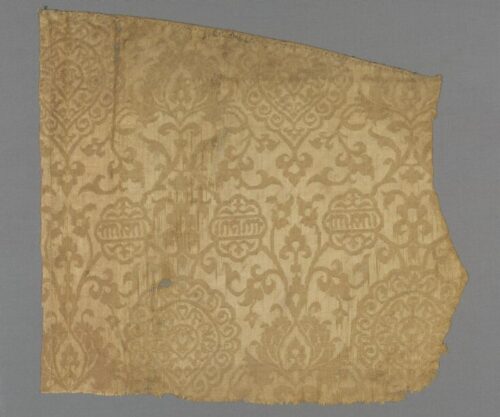
`Izz li-mawlana al-sultan/Translation Glory to our lord the Sultan. Inventory number 8614-1863. © Victoria and Albert Museum, London/CC-BY-SA
In the later Middle Ages, silk in Europe was no longer an unattainable luxury imported at prohibitive cost from China. Instead, it had become an attainable luxury, desired by merchants and lesser nobles eager to parade what had formerly been confined to ecclesiastical and elite vestments. Although the main supplier was Byzantium, silks were also produced and exported from the Levant, especially Syria and Egypt. Soon, from the mid-12th century onward, silks were also woven in Lucca, Venice, and other North Italian cities.
The demand for these middle-quality products was first detected in Italy, fostered by the Crusades and the Latin settlements in the Levant. Soon, however, they were also praised in chivalric literature. Later, in 1260, the Mongols entered the scene, once again providing oriental silks imported from the Far East. These products were known as panni tartarici (“Tatar cloth”). Meanwhile, designers and artisans moved back and forth along the Silk Road.
Some of these textiles were adorned with Arabic tiraz inscriptions referencing the ruler. Originally quite specific, these inscriptions became fashionable, merely conventional, and ultimately unidentifiable. Indeed, it appears that they had little meaning beyond signalling Western fascination with all things “oriental.” Especially favoured were roundels or medallions, a motif adopted by Italian craftsmen and weavers from Tatar cloths. This made it difficult for scribes to inventory such silks accurately, as Italian products were considered cheaper than the “real” thing. From the evidence adduced above, it is nevertheless clear that oriental silks originating in Alexandria and Damascus were regarded as prestigious objects.Thus, the English royal court continued in the 15th century to show a clear preference for silks bearing authentic oriental names. In general, though, silks marketed in Europe during the 15th century, became increasingly Italian in origin.
This shift was probably due in part to the introduction of technical innovations, such as the silk-throwing circular machine, first attested in Lucca in 1330. Another explanation may lie in the upheavals in the Levant following the Turkish and Islamic wars and the fall of Constantinople in 1453.
FEATURED PHOTO:
Detail of silk panel from Syria or Egypt in the 15th century © Victoria and Albert Museum, London, CC-BY-SA
READ MORE:
Oriental Silks go West: A declining trade in the Later Middle Ages.
By David Jacoby
In: Islamic artefacts in the Mediterranean world : trade, gift exchange and artistic transfer
Ed by Catarina Schmidt et al.
Collana del Kunsthistorisches Institut in Florenz, Max-Planck-Institut, vol 15 (2011)