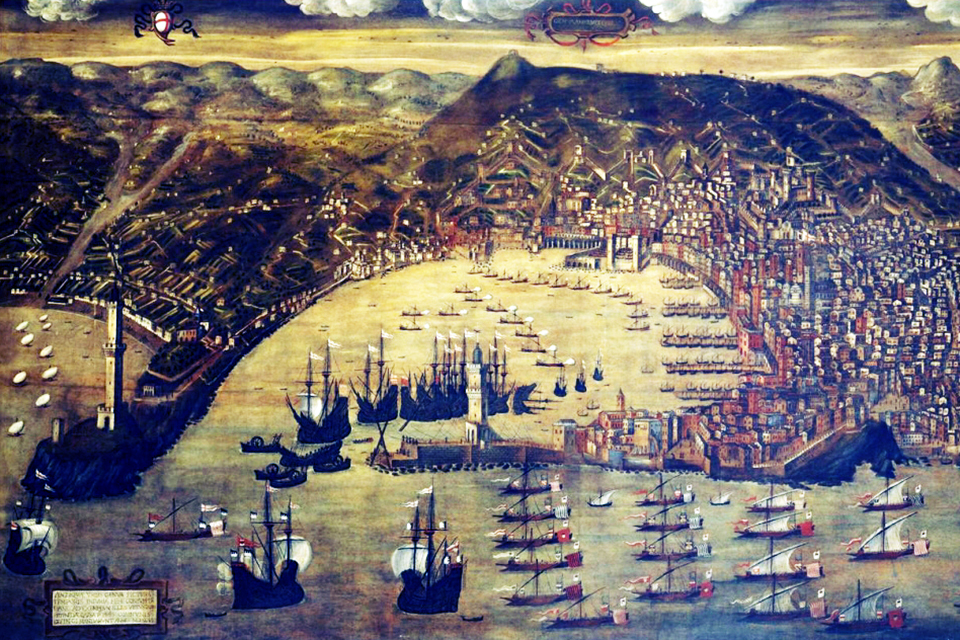
Silks, spices, fruits, jewels, glass… desired and coveted exotica were luxury products out of Syria in the Late Middle Ages. New Book by Myerson tells the story
The Desire for Syria in Medieval England
by E. K. Myerson
Cambridge University Press 2025
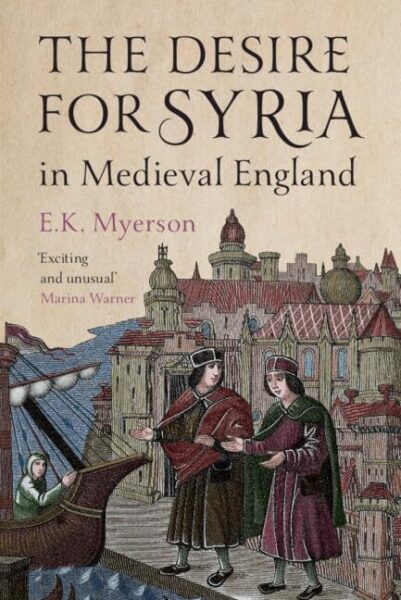 This book explores how desire for Syrian luxury goods reshaped English culture in the late Middle Ages. Focusing on the circulation of commodities known collectively as Syriana—sweet wines, spices, silks, jewels, and minerals—it shows how international trade connected England to the eastern Mediterranean and embedded the Levant deeply within English imagination, material life, and systems of meaning.
The study is anchored in a dramatic historical event. In June 1458, two English merchant ships returning from the Levant were attacked by pirates off the coast of Malta. Their captain, the Bristol merchant Robert Sturmy, was killed, and a cargo worth an extraordinary sum was seized. Recovered through legal records and inventories, this lost shipment provides a point of entry into a wider history of commerce, violence, longing, and cultural encounter.
Using this incident as a lens, the book reconstructs the afterlives of Syrian goods in medieval England. These commodities, once associated with the Holy Land and later traded through the markets of the Mamluk Empire, carried layered meanings: sacred, medicinal, aesthetic, and erotic. They circulated not only through ports and marketplaces, but also through texts, images, recipes, churches, workshops, and domestic spaces.
Drawing on archival research alongside art history, literary analysis, and theoretical perspectives, the book argues that Syriana functioned as a powerful cultural category. It shaped English art and language, transformed practices of medicine, cuisine, craft, and religion, and revealed an ambivalent relationship to the East—marked by fascination, appropriation, and desire as much as by fear or hostility.
By following these goods and the fantasies attached to them, the book reframes medieval England as a place formed through global entanglements. It shows how commerce and imagination worked together to produce enduring ideas about luxury, difference, and power—ideas whose legacies continue to shape the present.
ABOUT THE AUTHOR
E. K. Myerson is an artist, writer, and curator, currently studying at the Royal College of Art. His academic and creative writing has appeared in publications including GLQ, The TLS, Wasafiri Magazine, New Medieval Literatures, postmedieval, and Wellcome Collection Stories. He received his PhD in medieval literature from Birkbeck College in 2022, and have held postdoctoral fellowships at the Wellcome Trust / ISSF Fund, the Parker Library, and Emmanuel College, Cambridge.
FEATURED PHOTO:
Port of Genoa 1481. By Christoforo Grassi. © Galata Maritime Museum. Source: Wikipedia
READ MORE: