RESOURCE: People with a History: An Online Guide to Lesbian, Gay, Bisexual, and Trans* History
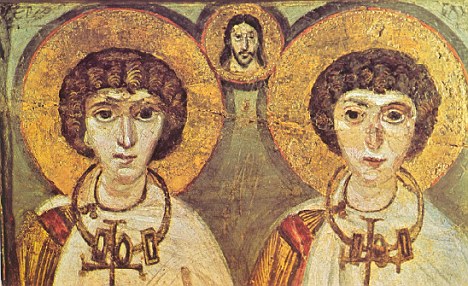
“People with a history” is a dedicated collection of sources and bibliographies, dedicated to LGBT-studies and maintained at Fordham University. The site provides an overall introduction to texts, sources, links and up-to-date bibliographies. This is where to start. Section II of this treats the Medieval Worlds. Apart from this indispensable material, the site presents the reader with an introduction to the history and theory plus introductory chapters to a list of special themes as well as an invaluable collection of links. One special page treats the scholar, who (together with Foucault) was instrumental in starting in tracing the history of homosexuality through the Middle Ages, John Boswell.
John Boswell
John Boswell (1947 – 1994) was a prominent historian and a professor at Yale University. Many of Boswell’s studies focused on the issue of religion and homosexuality, specifically Christianity and medieval homosexuality.
In 1980 he wrote the groundbreaking book on Christianity, Social Tolerance and Homosexuality, which was later heralded as winner of the National Book Award. In this book he formulated, what later was termed the “Boswell Thesis”. According to this it might be argued that neither the Bible nor the Christian tradition was nearly as hostile to homoeroticism as was generally thought. He thus proposed that homosexuals were accepted before the 13th century, and then intolerance sets in. Boswell thus rejected the idea that homosexual subcultures were a recent development.
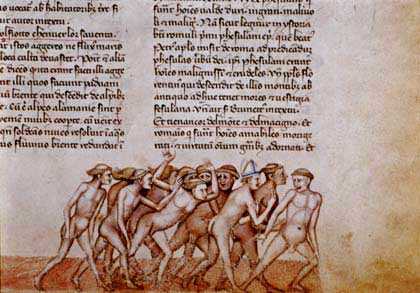
It stands to reason, this created an international stir among scholars as well as among homosexuals and in church-congregations. De facto he was responsible for launching medieval LGBT-studies. In later books he expanded upon his initial work, topping it off with Same-Sex Unions in Pre-Modern Europe in 1994, just before he died from AIDS-complications in the Yale infirmary. In this final oeuvre, John Boswell did a groundbreaking study of the “Adelphopoiia” liturgy, which Boswell argued, was for centuries used as a public liturgy to celebrate erotic relationships between people of the same sex. This work has, of course, been heavily mined by people working to get churches around the world to accept same-sex marriages.
His work as a scholar was obviously infused by a mixture of his officially declared religious stand (he had converted to Roman Catholicism in his youth) as well as his sexual orientation. According to Paul Halsall (who maintains a dedicated webpage to his memory), John Boswell was often “criticized as an “advocacy scholar”; some gay scholars, adhering to the secularist norm, simply dismissed him as a “Catholic apologist”. Others attacked him as a representative of the essentialist position, whereby homo-sexuality (or other sexual orientations) are not just considered “queer” but essentially “there” as physical and sociological facts. Finally he was attacked as a “pro-homosexual” for misreading and distorting texts, e.g. when he famously declared such spiritual leaders as Anselm for “homosexuals”.
Today most of his more adventurous readings of the source-material have perhaps been questioned. Nevertheless, his work still stands as a beacon and a poignant reminder, that the history of the Middle Ages should never-ever be read as just a straight story of regal saints, pious clerics, virtuous maidens, chivalric knights and down-trodden peasants.
Carolyn Dinshaw
Opposed to the tradition of John Bosswell stands the work of Carolyn Dinshaw. Carolyn Dinshaw is Professor of English and Director of the Center for the Study of Gender and Sexuality at New York University. She is author of Chaucer’s Sexual Poetics and Chaucer and the Text: Two Views of the Author. And then she is the author of “Getting Medieval: Sexualities and Communities, Pre- and Postmodern”.
In “Getting Medieval”, Carolyn Dinshaw (according to the cover of her book) “examines communities—dissident and orthodox—in late-fourteenth and early-fifteenth-century England to create a new sense of queer history. Reaching beyond both medieval and queer studies, Dinshaw demonstrates in this challenging work how intellectual inquiry into pre-modern societies can contribute invaluably to current issues in cultural studies. In the process, she makes important connections between past and present cultures that until now have not been realized.”In short: In her pursuit of historical analyses she embraces the heterogeneity and indeterminacy of sex and sexuality” placing herself squarely in the deconstructed and queer position in this field.
Mathew Kuefler
In 2005 the medievalist, Mathew Kuefler, finally thought it was time to take stock of the Boswell Thesis. This was accomplished though a collection of articles presented by the pantheon of medieval LGBT-scholars taking stock of his impact, the debates, which has surrounded his work and further presenting 6 new case-studies intended to illuminate the diversity of life-experiences of people in the middle ages.
SOURCE:
People with a History: An Online Guide to Lesbian, Gay, Bisexual, and Trans* History
READ MORE:
Other Literature: