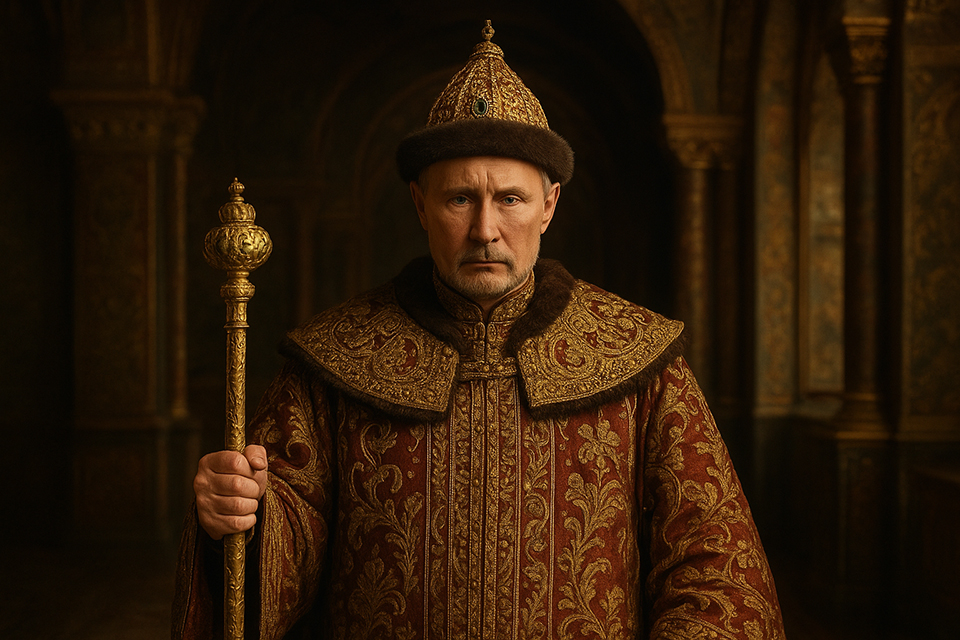
At his Alaska meeting with Trump, Putin made a curious demand that cut to the heart of the war: he wants to rule as Czar of a medieval-style empire
“Mr. Putin also demanded guarantees that Russian should be an official language in Ukraine, and that security should be established to allow the Russian Orthodox Church to be reinstated as the leader of the Orthodox Church in Ukraine”, wrote New York Times in a reference to Putin’s and Trump’s negotations in Alaska.
In truth, these demands appear downright bizarre. Consider the context: Russia has waged a war of aggression that, so far, has cost around a million Russian lives or ruined their health, without securing any meaningful territorial gains. And yet, Putin shows up in Alaska with demands that, beyond territorial concerns, peace should also reinstate the Russian language and the Russian Orthodox Church as national cultural focal points in the future Ukraine. Why is this so important to him? What is this war really about? Generally, three explanations are put forward:
Putin, the man
The first type of explanation is individual-oriented. Here we note that Putin, for one reason or another, appears as a character deviant. Maybe he is also ill (Parkinson’s has been mentioned). What we have witnessed since 2014, when Crimea was annexed, really looks from the outside like the work of a madman. For who else but psychopaths with delusions of grandeur start a war whose main manifestation is terror-bombings of civilians in Kyiv and the rest of Ukraine? And where more than a million Russian soldiers have ended up dead or maimed in the meat grinder of the battlefield since 2022?
Further on, commentators have attempted to dig deeper into Putin’s personal history. He was born in 1952 in Leningrad as the youngest son of a factory worker and soldier. His childhood home was undoubtedly also marked by a couple of other circumstances, namely that his grandfather had been cook for both Stalin and Lenin, while his mother was a dedicated churchgoer and believer. There must have been a certain “cognitive dissonance” in that home. In addition, it would have been marked by the stories of one of his two brothers, who died of hunger in Leningrad in 1942. The Revolution and the war would have been ghosts that haunted his childhood and youth. After school and university, where he studied law and economics, he was recruited in 1975 to the KGB. He then served in the GDR as liaison officer until 1989. After the coup against Gorbachev, however, he changed horses in midstream to support the restoration of the defunct Russia. In 1998 he was appointed head of the FSB (the KGB’s successor), until he was elected president in 2000. Might this be enough of an explication? Somehow, it does not quite suffice to explain the odd demands quoted here. We need more context
Putin, the medieval emperor
Although the sources are sparse, there is a straight line from Putin’s deeply felt regret over the collapse of the Soviet Union to his self-proclaimed preoccupation with Russia’s medieval history and the Russian Orthodox Church. He has himself mentioned this as a background for his political positioning.
This preoccupation with the Middle Ages is clearly linked to his desire to re-establish the world order that prevailed before the invention of the “nation” in the 1500s as the primary political “actor”. In short, the idea of a Europe of imagined communities configured as nations consolidated during the 15th and 16th centuries, to be finally codified in 1648 in Westphalia. Since then, the idea spread in a way that made it seem “natural.” Today in the Western world we no longer think in terms of empires, but rather nations shaped by the basic dictum: cuius regio, eius religio, with our addition, eius lex. The original dictum was confirmed in 1555 in Augsburg, though first formulated in 1582. It means: “Each kingdom, its religion (and its law.)”
The consequences of this “naturalness” with which we live with the national idea were according to his own words experienced acutely by Putin when the Russian Empire definitively collapsed after 1989, and everything from the Baltic States to Kazakhstan broke out of the Soviet imperial iron fist.
Putin, the latter-day Czar
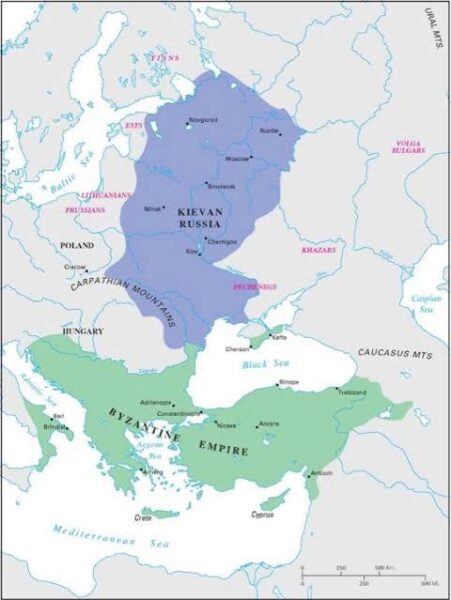
Thus, there seems at least on the discursive and narrative level to be a clear connection between Putin’s loathing of the idea of “national independence,” his desire to restore “the Russian Empire,” and his preoccupation with Russian history as rooted in the Kievan Rus’ Empire.
From about 880–1100 a group of Nordic Vikings ruled over a huge territory that stretched from the Black Sea to the tundra in the north and across the Pontic steppe to the German forests in the west. Although this empire waxed and waned, it ruled the territory until 1240 when the Mongols sacked Kyev. Only with the Mongols’ final defeat by the Russians in 1480 did the center of gravity finally move eastward to Moscow. Apparently, it is this Viking empire that Putin has feared might re-emerge as a strong economic center. One, which perhaps even in the long run draw Belarus into its orbit, further reducing Russia to an even more insignificant periphery – a nation among other nations, leaving the global scene to USA, China and India.
To put it simply: Just as Ivan the Terrible and Peter the Great had ambitions of being almighty Czars, the same applies to Putin. In this game he has of course received financial support from the oligarchs, who early on understood how to seize the Soviet Union’s massive natural resources, including the vast gas deposits. Lately, there was presumably a growing concern among these power brokers that Europe was moving toward a sustainable transition to more CO₂-neutral energy production, energizing the plans for “more control”. And following this, the war on Ukraine.
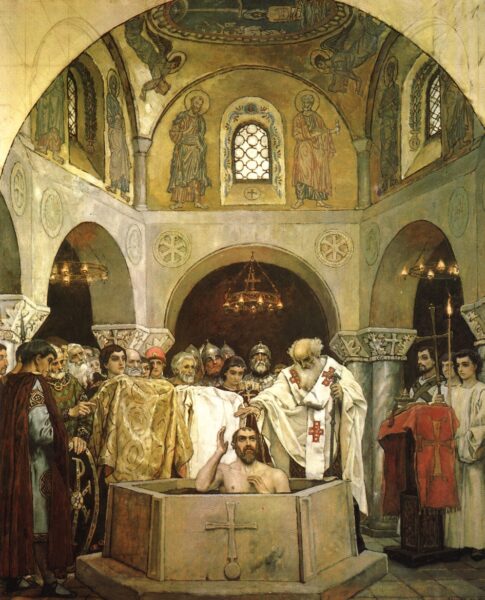
Given these economic interests, it is nevertheless significant that throughout the lead-up to the war in 2014 and the massive escalation of hostilities after 2022, Putin has consistently advanced “cultural,” “historical,” and “religious” rather than economic reasons for the war’s necessity.
Thus, Putin has also found support in the Russian Orthodox Church and its ambitions to once again control the Ukrainian church, which achieved independence in 2019 as a result of the schism between the leadership of the Russian church and the Ecumenical Patriarch in Constantinople. It is probably another reason why Putin could be quoted by the New York Times as having stipulated that supremacy over the Ukrainian church must again lie in Moscow.
These historical and cultural narratives have from the very beginning been intertwined and fairly unambiguous. The story is that Ukraine had adopted the West’s decadent culture and was heading toward membership in the EU (and perhaps NATO). Since Ukraine, however, had historically always been the starting point for Russia and therefore a natural part of the Russian Empire, this was an intolerable situation for an imperialist like Putin. In his view, Ukraine could not, historically speaking, continue as an independent nation.
Putin, an imperialist?
It is clear that in Putin’s eyes only empires should exist – that is, centralized spheres of power – and not nations. Which, incidentally, is a perspective he shares with Trump, who also regards nations – for example Canada and Greenland – as political perversions.
But the explanation is not only cultural and historical. It is also economic, in that we are observing here a former centre’s attempt to recapture its previous identity as an empire.
In other words: an entirely necessary insight from what in the social sciences is called “World System History” seems crucial to understanding what is happening.
Within this framework of understanding, Ukraine must be characterised as a former periphery that managed to stage a revolt against the former weakened centre’s economic exploitation. Culturally, Ukraine then escaped by reinventing itself as a cosmopolitan Western country complete with southern-style cafés, its own church, its own language, and a magnificent nature. In an increasingly tense militarized environment in Moscow and its surroundings, the newly established periphery – the nation-state Russia – then prepared to subjugate the former periphery in order, at the same time, to re-establish the Russian Empire as culturally superior and thereby (also) position itself as an economic power.
That Putin in this perspective has drawn heavily on the neo-medieval narrative of Russia’s cultural, popular, and economic superiority is no surprise. But in reality it is banal: it is about strong feelings of powerlessness and the dream of regaining power; and envisioning it as an empire.
It amounts to an almost medieval approach to the future world order of the 21st century.
Karen Schousboe
READ:
World System History. The Social Science of Long-Term Change.
Ed. by Robert A. Denemark, Jonathan Friedman, Barry K. Gills, and George Modelski.
Routledge 2008.
Coercion, Capital, and European States, AD 990–1900:
By C. Tilly
Blackwell 1990