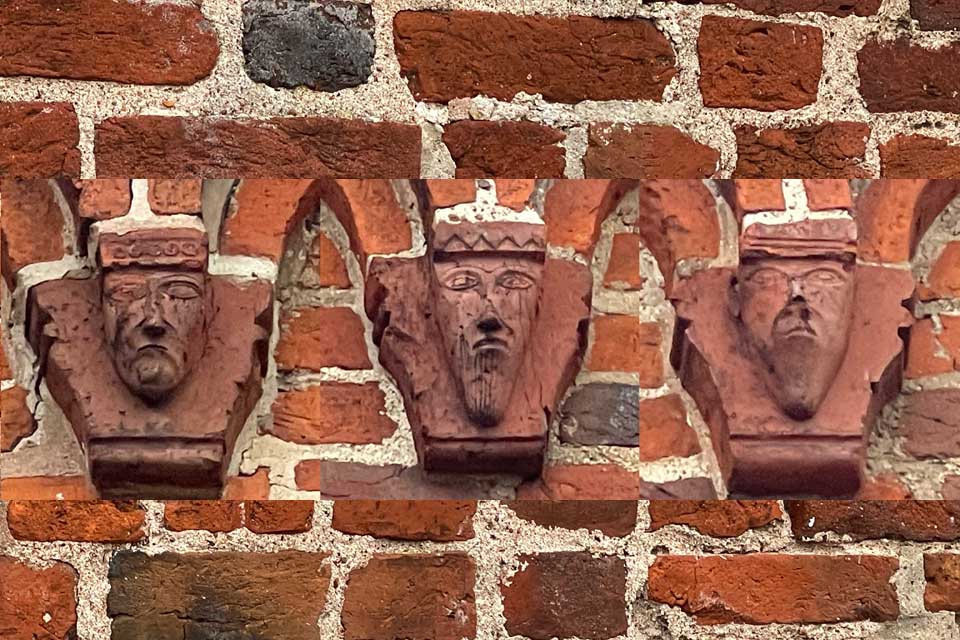
Tikøb church in Denmark is unique. It is an imposing example of an early 12th-century brick church. Foremost, though, it features a series of striking portraits shaped in burnt clay. Three kings and a bishop – and an abbot, a monk and a horse on the north wall? Who might it be?
Northern Spain is littered with Romanesque Art and Architecture. A huge restoration project recently recieved the prestigious Europa Nostra Medal 2013
Románico Norte – or Romanesque North – is the name of a huge and impressive project in Northern Spain. From 2005 to 2012 a plan was laid to institute a complete restoration of 54 churches in the diocese of Palencia and Burgos, in the old Merindad Aguilar de Campo district. The geographical area covered by the Plan focuses on the North Eastern part of the Northwest province of Palencia and Burgos, where the Southern slope of the Cantabrian Mountains meet the Castilian plateau. The vast territory with its distinct topography has posed a major challenge for the whole team trying to implement the objectives of the plan for the development of the “Romanesque North”.
The aim has been to further sustainable economic growth, through taking care of and developing the nature, history and heritage, which is embedded in the landscape. Accordingly the work is still in progress since not only the churches but also the surrounding landscape is being analysed, described and restored.
Iglesia de San Juan Bautista This has for instance been the case in the Iglesia de San Juan Bautista in Matamorisca, where the church is decorated with a series of very well preserved murals, which have been painstakingly restores. However, in order to provide lightening for the celebration of mass and other religious services, the church had installed a really terrifying lightening system – with ripe possibilities for fires. Further the old lightening hampered the visitor, who wanted to study the murals in detail. Apart from restoring the church, the work carried out by Románico Norte consisted in installing a state of the art lightening, where 95% of the fuses etc. were hidden and at the same time providing a better experience both for the local villagers and the cultural tourists.
Next year, the Cathedral of Notre-Dame de Paris expects more than 20 million visitors, celebrating the anniversary of this beautiful church. The first stone was laid in the presence of the Pope, Alexander III, in 1163. It took about a hundred years to finish the impressive edifice.
Complete with a new viewing platform, improved lighting, a renovated organ and – in a while – eight new bells, the Cathedral is looking all spick and span for the celebrations of the upcoming year. The lighting system is already in place, but the bells are still poured in Normandy at the bell-maker Cornille Havard. Overall, the Cathedral has raised €6.5 million from private donors to finance the ongoing projects.
The celebrations took off on December 12th, with the Parisian Cardinal-Archbishop Andrè Vingt-Trois celebrating mass at an evening service in the presence of ministers and a large crowd of other specially invited honoraries. Nearly 2000 took part in the event, which took place in front of the Cathedral.
At the same time, an interdisciplinary scientific symposium is taking place in Collège des Bernadins, where the focus is not so much on the building itself but on the religious life at the Cathedral through 850 years. The program may be viewed here.
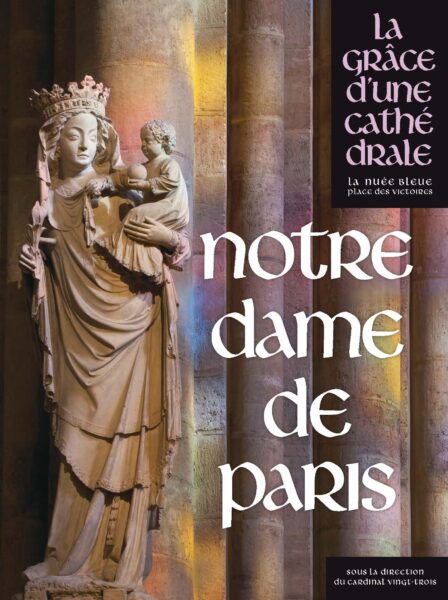
A heavy coffee-table book – 27 x 37 cm, 504 pages, 600 images and 2 kilos – has been published in connection with the anniversary. The book covers the history of construction from the 12th century up until now, and it tells the story of the building as a set piece for significant events in French history. The book is published in the series “La Grace d’une Cathédrale” by La Nuée Bleue Editions. The proceedings from the scientific symposium will be published later this year.
Stéphane Compoint
In connection with the anniversary the magazine Pelerin has hired the photographer Stéphane Compoint to take photos with his special technique. He uses a camera mounted on a balloon filled with helium, which he directs from below. A presentation of how this is done may be seen at the site of Pelerins. The photos may be enjoyed as part an E-pilgrimage taking seven days and inviting the pilgrim every day to enjoy and reflect upon the special sites of Notre Dame de Paris.