
Excavated since 1987, Finlaggan on Islay, demonstrates how the medieval Kingdom of the Isles was on par with the rest of Europe in terms of political and cultural sophistication
Ellan Finlagan lies in the middle of Islay and is a fair island in a freshwater loch. On this island of Finlaggan, the Lords of the Isles – when they called themselves Kings of the Isles—were accustomed to stay frequently for council meetings. They had this island well built with palace structures according to their old customs, within which there was a fine chapel. Near this island, at the distance of a stone’s throw, there is another island, somewhat smaller, fair, and round, on which they had their council house built. Because of this, the island is called in Irish Ellan na commharle, and in English it is called the Council Isle. 1549.
From: Monro’s Western Isles of Scotland and Genealogies of the Clans, 1549. Ed. by R. W. Munro. Edinburgh & London: Oliver & Boyd 1961
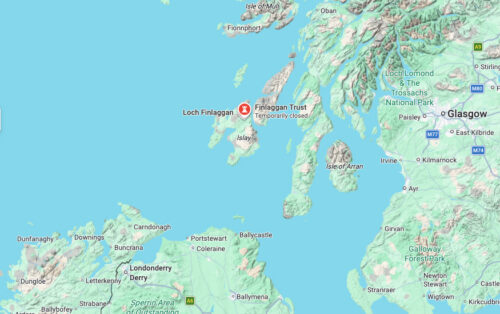 In the 10th and 11th centuries, the Western Isles of Scotland were known in Gaelic as the Rìoghachd nan Eilean, the Kingdom of the Isles, while the ruler was referred to in Gaelic as the “Ri Innse Gall”, “King of the Western Isles”. In Old Norse, however, the realm was called the Suðreyjar (hence the name Sodor). This epithet was coined in opposition to the Norðreyja, or Northern Isles (Orkney and Shetland).
Covering more than 8,300 km² of numerous isles, defending the northern seaway to and from Ireland, the overlordship was both well established and also contested throughout the history of the early and high Middle Ages by Irish and later Scandinavian rulers. At least from c. 900–950, it appears to have been recognised as a significant player in the north-western Viking diaspora. One ruler is known, Gofraid Crobán, who fought alongside King Harold Hardrada at Stamford Bridge in 1066. After him, five generations ruled the Isles, with their main base at the Isle of Man. During this period, a series of more or less murky alliances between warring rulers and chieftains on the Isles played on, and were played by, the Norwegian kings until 1263, when they were recruited to take part in the Norwegian invasion of Scotland, leading to the events of 1266, when the Isles became part of the Kingdom of Scotland at the Treaty of Perth. After the Isles recognised this overlordship, however, business appears to have continued more or less as before, filled with internal strife between the leading clans, of which the MacDonalds appear to have won the day in the long run. A new and very inspiring book tells the story of this kingdom from the point of view of the archaeological excavations of Finlaggan on Islay, providing a full report of the evidence gathered since 1987.
Finlaggan in the Landscape
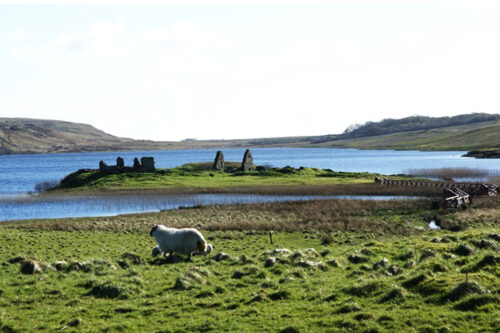
Located at the centre of the island, Finlaggan was obviously situated for defensive purposes and not for its soil or agricultural potential. A thin cover of stony-silty sand on a protruding rocky substrate meant the main use would have been rough grazing, assisted by the presence of the nearby lake with extensive marshland and meadows. To the east, the remains of a coppiced woodland are still found. Remains of the agricultural system attest to a classic combination of an Iron Age system of small, irregular fields enclosed by dykes. This system was later turned into an irregular infield/outfield system, which may have dominated during the heyday of Finlaggan, c. 1100–1300. Pollen analysis bears witness to a tundra-like landscape between 1000 and 1200, with a mixture of pines and birches interspersed with crowberries and grass. The population of the Hebrides in the Middle Ages is estimated to have been no more than 50,000 people, or approximately 6 persons per km², though this population density will have waxed and waned. This was an empty countryside.
Today, Finlaggan is the name used for a historic site located on two islands in a lake in the middle of Islay. It is believed that the name derives from Findlugan, one of St Columba’s companions, and in the Middle Ages one of the two small islands was known as the Island of St. Findlugan. The history of the toponymy is not particularly clear. today, the two islands are known as Eilean Mòr (the Large Island) and Eilean na Comhairle (the Council Island or the Little Island).
The Early Castle at Finlaggan
The archaeologists have shown that Finlaggan was continuously inhabited from the Stone Age up until AD 1100. Thus, the chapel and the burial ground testify to an early medieval settlement. However, virtually no remains of an elite residence have been identified prior to that date. After 1100, the evidence, however, becomes abundant, showing that Finlaggan became a vibrant centre of lordship between AD 1100 and 1300.
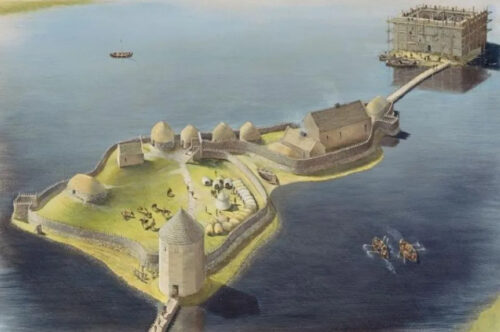
Here, archaeologists have excavated a substantial castle dating to before about 1300, to be superseded by a palace consisting of a hall, houses, and other buildings belonging to the Lord of the Isles. Obviously, this was the lair of the Lord of the Isles during the period when the Sea Kings were operating as (more or less) independent rulers.
In the 12th century, the landscape became dominated by a very substantial tower or castle raised on the small island and connected to its bailey, built on the larger island, where a hall dominated the layout, protected by a palisade. Inside this compound were also located the chapel and a burial ground inherited from earlier on. This plan conformed to the classical European model at the time, showing that the Kingdom of the Isles, albeit located on the periphery in the north-west, was culturally well versed in the idea of the “feudal landscape”. To this landscape belonged the tower, measuring 19 × 19 m (361 m²), and described by the archaeologists as a classical “Norman keep”. Such large rectangular stone towers were the signature buildings erected by Anglo-French lords and kings. As none are known to have been constructed by Scottish magnates, the tower at Finlaggan would have been read as a powerful political declaration of superiority of the realm.
While the tower may have provided the ultimate defensible “treasure house” and private living quarters, the excavation of the midden near the hall shows this was used for communal feasting, consisting of good cuts of deer, cattle, sheep, or pigs. Served roasted rather than boiled, it would have been accompanied by condiments as well as butter and cheese. In the midden, archaeologists also uncovered almonds, walnuts, and cherries, while imported jugs point to the consumption of claret, and a musical string tells us that a professional harpist provided entertainment.
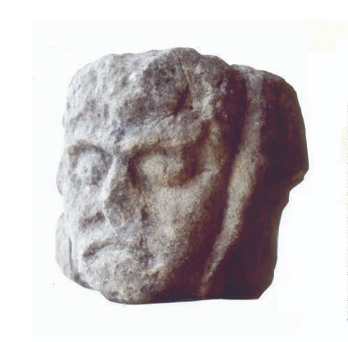
This hall also appears to have been built in the 12th or 13th century, measuring 16.3 × 7 m (114 m²) and fitted with a central fireplace. The entrance to the hall may have been intended to signal grandeur, albeit the size was not in itself particularly impressive. Archaeologists found the remains of what might have been a hood-mould with a stop in the form of a human head cut out of stone.
While the size of the Finlaggan hall was only a quarter of the still-standing Håkon’s Hall in Bergen, Norway, the complex compares well to John de Courcy’s castle at Carrickfergus in Ulster from the same period, and to Castle Rushen, one of the other main administrative and residential centres of the kings of the Isles.
Who Built the Castle?
Historians point to Rǫgnvaldr Guðrøðarson, great-grandson of Gofraid Crobán (Godred Crovan), as the likely entrepreneur. Rǫgnvaldr ruled from 1188 to 1226. The main source for Rǫgnvaldr and his reign is the thirteenth- to fourteenth-century Chronicle of Mann, a historical account of the rulers of the Hebrides and Mann– the Croban dynasty in particular– which survives in a Latin manuscript dating to the mid-fourteenth century.
Another contender might be Ranaldr, son of Somerled, whose descendant, Aonghus of Mor, is famous for the praise poem he received at the death of his father in c. 1247. The anonymous poet is apparently owed a recompense from the dead father, which he proceeds from afar to wrangle out of the purse of Aonghus by sending him a poem of praise. (The poet is afraid to cross the white, green-washed, swelling sea and sleep on the ship, he tells us, which means that he will not meet up at the court of Aonghus.)
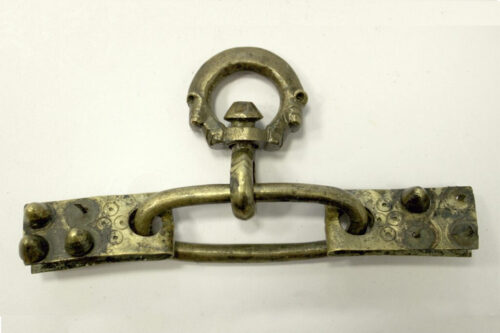
The poem is a fascinating commentary on the life world of one of the kings, who at some point may have stayed at Finlaggan. In the poem, we hear of Aonghus’ inheritance from his father– his connection to a royal dynasty, his kingly status (his “seat”), and the paraphernalia thereof. We hear that Aonghus has inherited from his father his breastplate, jewellery, spears, curved swords, treasure chests and (probably) brown ivory chessmen, while his hounds and their dog collars (one such has been found at Finlaggan) are also mentioned. He is, indeed, a music-king, that is, a lover of bardic poetry. Moving further out from his personal accoutrement, we find that Aonghus has inherited grand castles, loyal peasants and, with them, income from the land, as well as ships and steeds. To this part of his world also belongs his entourage – his loyal men and fierce warriors. With all this, he is able, to raid each shore. “Scarce is the strand where you have not taken treasures,” we hear.
The Elite Residence c. 1300–1500
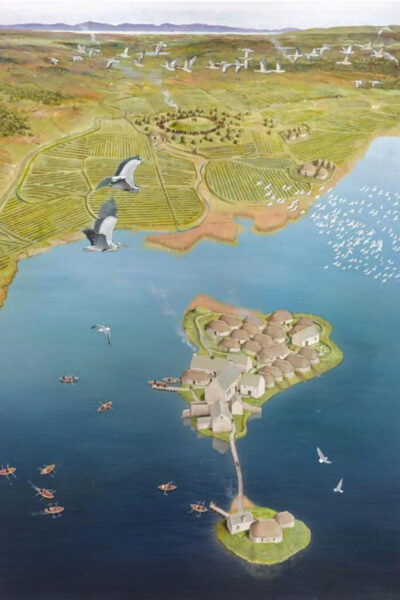
Later, the castle was repurposed and rebuilt by the chiefs of Clan Donald, who served as Lords of the Isles after their incorporation into the Scottish kingdom. There is evidence that the castle was totally repurposed after a local strife between the MacDonalds and the MacDougalls, as the former reported that their lands had been devastated and burned in 1297. However, no signs of these events have been excavated. What has been found are the remains of a palace where defensive measures were considered archaic and obsolete. While the north-east of the larger island may have been reserved for a paddock, access to the island was now achieved by boat landing on a jetty in front of the hall, which may have been intended to emit an atmosphere of welcome. With a surplus of guesthouses, pantries, butter houses, and probably storehouses, the layout signalled a large “conference centre” rather than a lordly residence. Coupled with the meeting house where the now flattened tower had stood, the function had shifted. David Caldwell, responsible for 40 years of excavations and explorations of the site, has suggested that Finlaggan may have been an early “Thing” site, which was used for inauguration ceremonies. After the building of the castle and later, the palace, this function continued to be serviced by the Lords of the Isles.
Remains of a private compound to the east of the chapel may indicate the location of the lord’s private quarters while he was in residence. However, while the evidence for daily life is copious for the first phase, the second is less abundant.
New Book
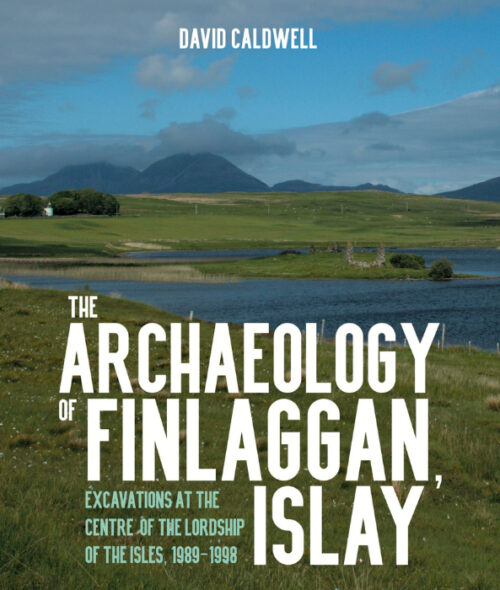
The depiction above sums up some of the general conclusions presented in a new open-access book revealing fresh details about the archaeological excavations at Finlaggan on Islay, a site long linked to the Lords of the Isles. The study argues that the loch’s islands were not just symbolic, but the working centre of a semi-independent kingship and later lordship within Scotland.
The Archaeology of Finlaggan, Islay brings together the results of a major archaeological project carried out between 1989 and 1998, followed by nearly 30 years of analysis. Issued by the Society of Antiquaries of Scotland, the book offers a comprehensive account of the excavations and the material uncovered at Finlaggan. As such, the book presents evidence that Finlaggan served as the ceremonial, administrative, and judicial heart of the Lordship of the Isles, a quasi-independent power in the 14th and 15th centuries. It also reports the remains of a previously unknown and unnamed royal castle dating to the 12th and 13th centuries, suggesting that the site’s importance stretched further back into the medieval period than previously recognised.
The book is written by the archaeologist David Caldwell, who directed the project on behalf of National Museums Scotland. Caldwell later served as President of the Society of Antiquaries of Scotland from 2014 to 2020 and emphasised the scale of the effort:
“I am privileged to have led a skilled and dedicated team of specialists and volunteers on such an important project at a key place of national significance. The processing of all the data that was gathered has been a major part of my life since the 1990s, and I hope I have not only provided an account of interest, but also a basis for others to carry out more research in the future,” he tells in an interview with National Museums Scotland.
The book is highly recommended.
Karen Schousboe
FEATURED PHOTO:
Finlaggan. © Jaime Pharr/Dreamstime 19463497
SOURCE:
The Archaeology of Finlaggan, Islay: Excavations at the Centre of the Lordship of the Isles, 1989–1998
Ed. by David Caldwell
Society of Antiquaries of Scotland 2025. Published as Open Access.
An Address to Aonghus of Isley.
From: O Bergin: Irish Bardic Poetry.
Dublin 1970
READ ALSO:
 McDonald, R A 1997 The Kingdom of the Isles, Scotland’s Western Seaboard,
c.1100–c.1336.
East Linton: Tuckwell Press. 1997
 McDonald, R A 2019 The Sea Kings: The Late Norse Kingdoms of Man and the Isles, c. 1066–1275.
Edinburgh: John Donald 2019
 A New History of the Isle of Man: Volume 3, The Medieval Period, 1000-1406
Ed by Sean Duffy and Harold Mytum
Liverpool University Press
 Kings, Usurpers, and Concubines in the ‘Chronicles of the Kings of Man and the Isles’
by R. Andrew McDonald
Palgrave 2026
Older, free translation of the Chronicle available here
A Mighty Fleet and the King’s Power: The Isle of Man, AD 400 to 1265
Ed by T. Clarkson and John Donald, 2023
Routledge 2023
READ ALSO: