Home » Medieval Histories » Page 39

Category: Medieval Histories

‘Medieval Histories’ offers medievalists all the news about exhibitions, books, research, archaeology, travel-tips and much more from the Medieval World

Rose Window in Sainte-Chapell, Paris

Sainte-Chapelle Shines Again

It took seven years to restore the glorious windows of the Sainte-Chapelle and cost €9.5 mill. Now they shine in all their former glory

Sainte-Chapelle being restored
Sainte-Chapelle being restored © Centre des Monuments Nationaux

Sainte-Chapelle was commisoned by Saint Louis after he had bought a number of very important relics stemming from the Passion of Christ from the Byzantine emperor. Especially important was the Crown of Thorns, which arrived in Paris in 1239. When the royal chapel was consecrated in 1248, it appeared the architect had succeeded in creating a veritable jewel-box to hold this very precious relic. Part of this aura was due to the magnificent glass paintings, which seemed to soar into the sky.

With more than 750 m2 and 1113 scenes they still tell the story of the chosen people. The cycle starts at the western bay of the north wall with scenes from the Book of Genesis. The next ten windows of the nave follow clockwise with scenes from Exodus, Joseph, Numbers/Leviticus, Joshua/Deuteronomy, Judges, (moving to the south wall) Jeremiah/Tobias, Judith/Job, Esther, David and the Book of Kings. The final window, occupying the westernmost bay of the south wall brings this narrative of sacral kingship right up to date with a series of scenes showing the rediscovery of Christ’s relics, the miracles they performed, and their relocation to Paris in the hands of King Louis himself. In the apse windows feature scenes from the Infancy, Life of John the Baptist and the Passion. The overall message is to exalt the ideal of kingship.

It stands to reason that these paintings were harmed, changed, restored and mixed anew during the next 750 years. Not least the French Revolution caused a grievous destruction. Nevertheless, 2/3 of the windows are original.

In the 1970s, however, it was deemed necessary to restore this magnificent French monument in order to bring it back to its former glory. Finally, a few days ago, the result of the final restoration-project was unveiled to the astonishment of everyone present, who had never seen the edifice without scaffolding and partially under wraps. Indeed a glorious moment!

The primary donation to finish the restoration of the bay-windows has been made by the Danish Company: Velux, which contributed 50% of the expense. The president of the Velux foundation, Lars Khan-Rasmussen, was present at the inauguration, where he committed further funding for another French treasure, the windows at Palais d’Antin. The foundation has earlier on been active in for instance the rebuilding of the Dresden Frauenkirche and is active in a European context, whenever a restoration job touches upon the primary business of the Velux company: to bring daylight and fresh air to people. At the ceremony in Paris on the 20th of May 2015, the Velux Foundation was profusely thanked by the president of the Centre des Monuments Nationaux for its never wavering support and its exemplary way of supporting such a complicated project.

SOURCES:

La Sainte-Chapelle comme vous ne l’avez jamais vue

Les Fondations VELUX dévoilent ce jour le nouveau visage de la Sainte-Chapelle

Atelier Vitrail France

SEE MORE:


READ MORE:

la Sainte-Chapelle a Paris CoverLa Sainte-Chapelle de Paris 
By Françoise Perrot
Series : Regards
Editions du Patrimoine Centre des monuments nationaux 2013
ISBN-10: 275770270X
ISBN-13: 978-2757702703


La Sainte Chapelle Relie coverLa Sainte Chapelle Relié
By Jean-Michel Leniaud and Françoise Perrot
Series: Monographies
Editions du Patrimoine Centre des monuments nationaux 2007
ISBN-10: 2858229201
ISBN-13: 978-2858229208


Vitrail coverVitrail, Ve-XXIe siècle
By Véronique David and Michel Hérol
Editions du Patrimoine Centre des monuments nationaux 2013
ISBN-10: 2757703439
ISBN-13: 978-2757703434

Dressing the Part -cover cropped

Medieval and Renaissance Studies 2015

Brepols Publishers: Medieval and Renaissance Studies 2015

This catalogue presents the 2015 programme of English titles published by Brepols inside Medieval & Renaissance Studies

Some highlights this year are:

Brepols publishers 2015 medieval cover THE MEDIEVAL COUNTRYSIDE

Peasants and Lords in the Medieval English Economy. Essays in Honour of Bruce M. S. Campbell

Crisis in the Later Middle Ages. Beyond the Postan–Duby Paradigm

Land Assessment and Lordship in Medieval Northern Scotland

Power and Rural Communities in Al-Andalus. Ideological and Material Representations

MEDIEVAL CHURCH STUDIES

Devotional Culture in Late Medieval England and Europe. Diverse Imaginations of Christ’s Life

The Secular Liturgical Office in Late Medieval England

Women in the Medieval Monastic World

Nuns’ Literacies in Medieval Europe

A Mendicant Sermon Collection from Composition to Reception

ART AND VISUAL CULTURE

Visual Constructs of Jerusalem

Catalogue of Paintings in the Collection of the Society of Antiquaries of London

Dressing the Part: Textiles as Propaganda in the Middle Ages

This is of course only a tiny selection. Do Download this catalogue with Brepols’ new and forthcoming English-language titles in Medieval & Renaissance Studies for 2015.

pieve di monte sorbo interior

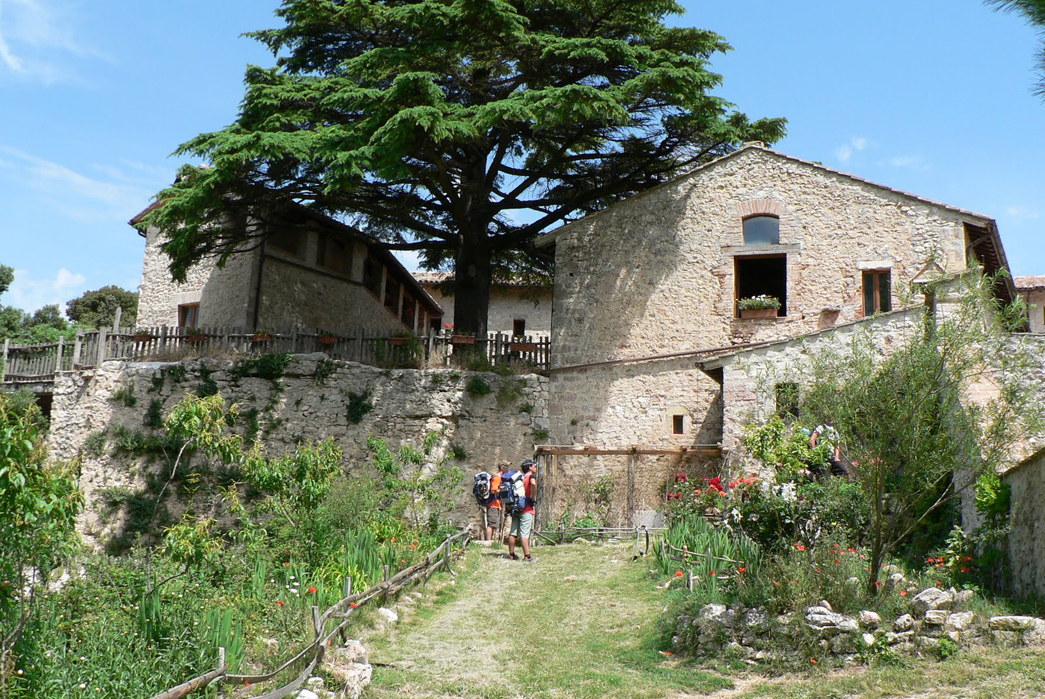
Maria Annunziata di Monte Sorbo

Along a small scenic route leading into the hilly countryside not far from Sarsina on the motorway between Ravenna and Citta di Castello lies a small church at Monte Sorbo. Although secluded it is well worth a detour.

Read more

Angilbert tomb meaux wikipedia

The Ransom of the Soul

In his latest book, Peter Brown explores the transition of the Christian ideas of afterlife from AD 250 – 650. This shift laid the foundation for the heartfelt despair and fear, which came to foster the wealth of countless religious institutions, hospitals and churches in the Middle Ages.

The Ransom of the Soul. Afterlife and Wealth in Early Western Christianity

By Peter Brown
Harvard University press 2015
ISBN: 978-0-674-96758-8

The memorial slab of Trasemirus Narbonne 7th century
The memorial slab of Trasemirus Narbonne 7th century. Notice how the physical lay-out of the slab echoes those of Visigothich belt buckles.

Around AD 600 the Visigoth, Trasemirus, from Mandourelle in the region of Aube was commemorated by an oblong slab, measuring 33.8 cm x 51.4 cm. The main part of the memorial plaque is covered with three carved processional crosses and two facing doves. The inscription is relegated to the frame above and to the right of the central carving and seems to have been something like an afterthought. However, quite innovative, the inscription contains a phrase, which came to resound for the rest of the Middle Ages: “In the name if Christ, all men pray for the soul of Trasimeus, who came to rest [at this time?]. His body lies in this tomb. May he live eternally in Christ” [1]

There are several interesting features connected with this slab (the roughness, the manner of carving etc.) However, as Peter Brown points out in his latest book, this is one of the first instances from the continent, where the deceased is no longer praised or – so to speak – raised to the skies – but rather envisioned as a participant in a procession moving towards God. On this spiritual journey the soul of Trasemirus most of all needed the our intercessional prayers. According to his world-view, his journey through afterlife was a long and dangerous pilgrimage on which he would – without doubt – have to move through a terrible harsh wasteland, meeting an assortment of devils and angels, each metering out the exact penance he owed for his transgressions committed in his earlier life. In front of him and his fellow pilgrims would be carried the three procession-crosses depicted on the slab.

The ransom of the soul CoverAs medievalists, we know this netherworld so well, that we are not really struck with its formula nor its stark and scary character. What, perhaps, we do not know as well is how this world-view came about.

Luckily Peter Brown has once more come to our help. In a new book “The Ransom of the Soul” (Harvard 2015) he once again delights us with one of his exquisite readings of the writings of the series of learned theologians and intellectuals, he has so often visited in his life’s work. Augustine, of course, figures; but so does also the bishops of Arles (Honoratus, Hilarius and Caesarius) as well as more obscure persons as Leudegar, Barontus and finally Columbanus and Trasemirus (from the 7th century). Those of us, who are familiar with the work of Peter Brown, will have met them before.

However, here we meet them as proponents of a sort of “side-story” to (although emphatically not a spin-off of) his latest book: Through the Eye of a Needle, which dealt with the question of the use of wealth in the Christian churches and how ideas and practice about this embarrassing issue changed over time, reflecting the changed circumstances of people from the 4 – 8th century.

Thus, this story is not about the wealth itself and the Early Christian ideas of how to deal with it – how to invest in “Heaven” and be saved – but rather the very specific ideas about the “other world”, which fueled these changes in the lifestyles of the Early Christians. Guided by the pen of Peter Brown we thus accompany Romans in Late Antiquity, who believed that they would enter the Milky Way and a starry afterlife, according to the precise status, which they had accrued in this life. And we meet them, when they are busy sharing meals and holding funeral feasts next to the graves of their family-members; or when saving up in heaven through alms-giving in Hippo at the time of Augustine. But we also learn how these rather pleasant ideas of a Heaven consisting of a shaded and cool refrigerium, where the dead would spent their time in leisurely pursuits while awaiting the second coming, changed from AD 250 – 650. Too placid and not enough mindful of our sinful nature and daily transgressions, another view of the next world surfaced in Early Christianity. Gradually the impending judgement entered the scene more forcefully, forever changing the elegiac tone into a sombre hue. “A new gripping sense of peril” came into being, writes Peter Brown, while exploring the many stepping-stones towards the finale in the 7th century, when all that mattered was to try as best one could to settle the score while alive through incessant almsgiving, soul-searching, prayer and penance; and at the same time seeking and securing future intercessions of others through constant praying (saints, family, friends, or just passers-by).

His aim, though, has not been just to tell the story of how different theological discourses on the afterlife and pending judgement fed on each other and the wealth of the future Catholic Church. The idea has much more been to explore the way in which these changes were directly caused by the changing political circumstances in the transition from Late Antiquity to Early Medieval Europe. This is not a “how-book” but a “why-book”, writes Peter Brown.

This makes the book especially valuable. It should be able to inspire archaeologists, who have long toiled with debates on how to understand shifts in burial practices and funeral memorials in this period; but who do not quite know, what profound theological and ideological debates framed and fed these changes.

In this sense it is very pertinent that the book ends with Peter Brown recounting the memorial of Trasemirus. Hopefully, the book will inspire readers from a wide spectrum of academic disciplines working on this period. Not least archaeologists!

This book is based on lectures delivered at the Institut für die Wissenschaften vom Menschen in Vienna 2012.

Karen Schousboe

NOTES:

The memorial slab of Traseminus is kept in the Musée Archaéologique de Narbonne (no. 198/4168)

El epitafio de Trasemiruas (Mandourle, Villesque des Corbiéres, Aude)
By Gisela Ripoll López and Isabel Velásquez Soriano

READ MORE:

Through the eye of a needle coverThrough the Eye of a Needle: Wealth, the Fall of Rome, and the Making of Christianity in the West, 350-550 AD
By Peter Brown
Princeton University Press 2012
ISBN: 9780691161778
ISBN: 9780691152905


FEATURED PHOTO:

The tomb of Bishop Agilbert may present us with one of the earliest Last Judgement Scene – Meaux, France ca. AD 690

Chateau de Vincennes-donjon-wikipedia

Château de Vincennes

Situated in an odd corner of suburban Paris, this castle is seldom on the itinerary of the cultural tourist. After an extensive renovation ending in 2010, in It deserves a visit.

Read more