Home » Medieval Histories » Page 50

Category: Medieval Histories

‘Medieval Histories’ offers medievalists all the news about exhibitions, books, research, archaeology, travel-tips and much more from the Medieval World

European Journal of Archaeology, Vol. 17, Issue 1, 2014

European Journal of Archaeology, Vol. 17, Issue 1, 2014

The European Journal of Archaeology is published on behalf of the European Association of Archaeologists (EAA)

Vol. 17, issue 1 (2014)  holds a series of articles especially pertinent for medievalists:

Spatial and Temporal Trends in New Cases of Men with Modified Teeth from Sweden (ad 750–1100)
Anna Kjellström
pp. 45–59

The Hanseatic Cultural Signature: Exploring Globalization on the Micro-Scale in Late Medieval Northern Europe
David Gaimster
pp. 60–81

The Medieval Europe Research Committee (MERC)
Martin Carver
pp. 82–82

Ecological Approaches in Medieval Rural Archaeology
Rainer Schreg
pp. 83–119

The Maritime Middle Ages—Past, Present, and Future. Some Ideas from a Scandinavian Horizon
Christer Westerdahl
pp. 120–138

Fasti Online -map

Fasti Online –

Fastionline aims to provide a database of classical and medieval archaeological excavations in Italy and elsewhere in Europe.

Fasti Online is a project of the International Association of Classical Archaeology (AIAC) and the Center for the Study of Ancient Italy of the University of Texas at Austin (CSAI)

About Fasti

Between 1946 and 1987 the International Association for Classical Archaeology (AIAC) published the Fasti Archaeologici. It contained very useful summary notices of excavations throughout the area of the Roman Empire. However, spiraling costs and publication delays combined to render it less and less useful. AIACs board of directors thus decided in 1998 to discontinue the publication and to seek a new way of recording and diffusing new results. The Fasti Online is the result of this effort.

The aim of the site is to provide a database of excavations since 2000, providing a record in English and in the local language for each season. We do not pretend to offer information on all sites being excavated, and certainly not on those excavated in the past, or never excavated. Each participating country is responsible for uploading the data it gathers: some countries’ records are more complete than others.

The project was started with the support of the Packard Humanities Institute, to which we remain very grateful. It has subsequently developed partnerships with ICCROM, and the Center for the Study of Ancient Italy at the University of Texas at Austin, where the project will be housed on the University’s computers.

The project is now generously supported by the Baron Lorne Thyssen, the Italian Ministry for Cultural Heritage and Activities, the Society for the Promotion of Roman Studies,the Classical Association and the Oxford Journal of Archaeology. As part of the European Project ARIADNE we will receive 20% matching funds to continue the project over the next four years. The Ukrainian sites receive additional support from the Ukrainian Studies Fund of Harvard University.

FASTI is eager to welcome and support the entry of new countries into the project. For information on how to join FASTI contact Elizabeth Fentress, elizabeth.fentress@gmail.com

Scientific Committee: Michael Crawford, Stefano De Caro, Luigi Malnati, Adam Rabinowitz, Christopher Smith, Michael Thomas
Scientific Director: Elizabeth Fentress
Project Manager for Italy: Helga Di Giuseppe
Software and technical support: L – P : Archaeology

Using and Citing Fasti Records

Unless otherwise stated, all Fasti Online Data is licensed by AIAC under the Creative Commons Attribution-ShareAlike (CC BY-SA) license. As such, you are free to share, use and remix Fasti data, as long as you attribute the source data accordingly. When citing Fasti Site Records, please refer to the URL of the site and the date accessed. When citing Fasti Season Summaries please cite the summary authors, the year of the intervention, the URL and the date accessed.

Fasti FOLD&R publications are licensed separately under the Creative Commons Attribution-NonCommercial-ShareAlike (CC BY-NC-SA) license, with further information noted in the FOLD&R About page.

The project is supported by the Italian Ministry of Cultural Heritage (MiBAC), the Classical Association, the Society for the Promotion of Roman Studies, the Ukrainian Studies Fund of Harvard University and L – P : Archaeology.

Web, GIS and Database Design by L – P : Archaeology

All Fasti Online data, unless otherwise stated is licensed under the Creative Commons Attribution-ShareAlike Unported License (CC BY-SA 3.0), © 2004 – 2013 AIAC

Culture, Power and Identity in the Pre-Modern Mediterranean

CFP for Culture, Power and Identity in the Pre-Modern Mediterranean 02.01.2015 – 05.01.2015

The Mediterranean Seminar is seeking proposals for panels on “Culture, Power and Identity in the Pre-Modern Mediterranean,” organized by Brian Catlos [Religious Studies CU Boulder/Humanities UC Santa Cruz] and Sergio La Porta (Armenian Studies, CSU Fresno)  to be submitted for consideration for the annual meeting of the American Historical Association to be held January 2-5, 2015 in New York City.

Mediterranean Studies represents an approach that is transforming our view of the history of Pre-Modern Europe, North Africa and the Middle East by taking an inter-disciplinary and comparative approach to the history of the Medieval West (ie.: the area west of the Indus), by “provincializing” Europe, eschewing grand teleological narratives, and by interrogating essentializing categories that have dominated historical analysis when deployed uncritically and universally (e.g.: Christianity, Judaism, Islam, Europe, Byzantium, the Near East…).

We are seeking proposals that focus on the intersection of culture, power and religious and ethnic identity, on communal relations, and/or on processes of acculturation, translatio, and conflict in the broader Mediterranean.

In principle we will propose two panels: “Ideals” and “Action” — the former focusing on the ideology of pre-Modern identity politics and its expression, and the latter on the outcomes of  policy and practice in this regard.

Papers focusing on social, political and economic history are welcome, but we are particularly interested in papers that are interdisciplinary in nature and/or that focus on art history, musicology, architecture, philosophy, history of science and medicine, the construction of class and/or gender identity, material culture or literature, and/or that focus on traditionally understudied groups (e.g.: Berbers, Copts, Armenians) and/or that combine approaches or take a chronologically or regionally comparative approach.

Please submit a proposals for 20-minute papers to be presented in person to Brian Catlos (bcatlos@ucsc.edu) and Sergio La Porta (slaporta@csufresno.edu) on or before Thursday, February 6 for consideration. Include a 150-200 word abstract and a 2-page CV, and indicate whether you will need to request AV equipment, and put “AHA Proposal” in the subject line.

The Meditteranean Seminar


Talisman de Charlemagne

Charlemagne. The Times, the Spaces and the Peoples

Charlemagne. The Times, the Spaces and the Peoples – Construction and Deconstruction of a Medieval Kingdom.

(Le colloque international Charlemagne: les temps, les espaces, les hommes. Construction et déconstruction d’un règne).

The Programme presents a wide variety of papers on the Carolingian world. Papers are presented in German, French and English.

The colloquium has been organized by the German Historical Institute, Paris, and the following universities: Paris 1 Panthéon-Sorbonne, Paris Ouest Nanterre La Défense, Paris-Est Marne-la-Vallée et Reims Champagne-Ardenne. The members of the scientific advisory board are: François Bougard (Nanterre), Geneviève Bührer-Thierry (Marne-la-Vallée), Jean-Pierre Caillet (Nanterre), Patrick Corbet (Nancy), Philippe Depreux (Hamburg), Alain Dubreucq (Lyon), Rolf Große (Paris), Sylvie Joye (Reims), Martin Kintzinger (Münster), Régine Le Jan (Paris), Pierre Monnet (Frankfurt am Main), Yves Sassier (Paris), Michel Sot (Paris).

More information about the programme

Le colloque International Charlemagne: les temps, les espaces, les hommes. Construction et déconstruction d’un règne
The Colloquium takes place in Paris at l’Institut historique allemand, Paris.
26.04.2014 – 28.04.2014


Papal Biker

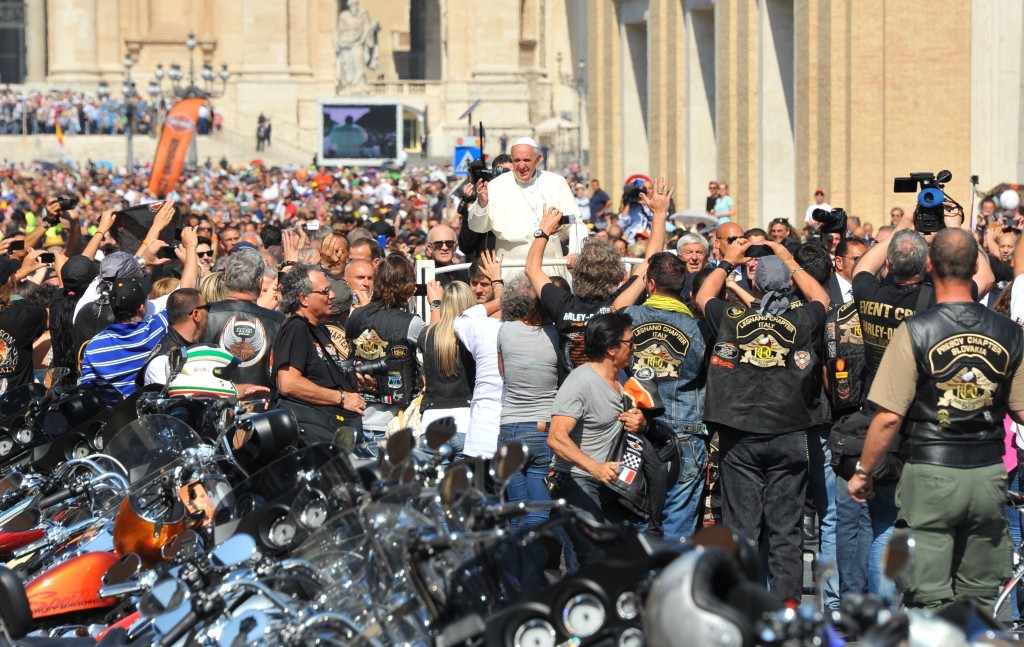
The present pope has a predilection for public transport. And apparently loathes the bulletproof papamobile. But will he return to the tradition of being carried around?

Summer 2013 Harley- Davidson presented the new Pope with a 1,585 cc Harley Davidson Dyna Super Glide, signed Francesco on its tank to mark the mortorcycle brand’s 110th anniversary. Now the Pope has put it up for sale at Bonhams at an auction next week in Paris.  The mortorcycle has been especially signed by the Pope and is accompanied by a leather jacket, also bearing his signature.

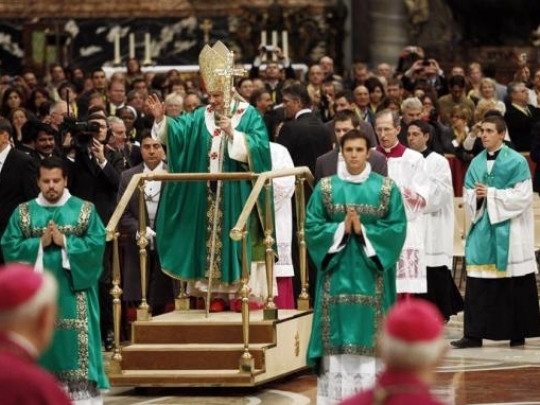
sedia pope

The proceeds will be given to Caritas Roma, a charity working on behalf of the Catholic Church. Another new invention has been the constant use of open “popemobiles” in order to increase the access of ordinary people to the ministry of the pope. After the assassination attempt in xxx the world experienced the pope enclosed in a series of more and more bulletproof display glass cases. This praxis was discarded during the visit to Buenos Aires’ last summer. And will probably continue, since it allows the Pope to interact in a very lively way with the crowds, as recently witnessed by the Pope inviting a friend from Argentina for a ride across the Piazza di San Pietro  in the current popemobile, which looks more and more like an ordinary platform truck painted white for the occasion. More privately the Pope is currently driving himself around in an ancient Renault4 from 1984, a gift from an old priest from Northern Italy. This followed his sale of the more ordinary Mercedes-Benz popemobile, which was sold earlier this year.

11_10_16_pope_platform

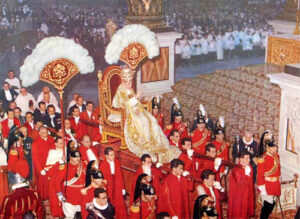
It is a fair guess that the present Pope is not going to experiment with introducing new forms of the traditional Sedia Gestatoria – or chair for carrying – as his predecessor did with the wheeled walker especially designed to lift him above the crowds. Benedict probably itched to be carried around as his forebears were up until 1978, in line with his rediscovery of carmine plush hats, red shoes and ermine; but he prudently refrained.

It is not quite known when the tradition of carrying the Pope around began. A fair guess, however, is that the tradition derived from the ancient ritual of carrying the newly elected Roman consuls though the city of Rome with their sella curulis in front.

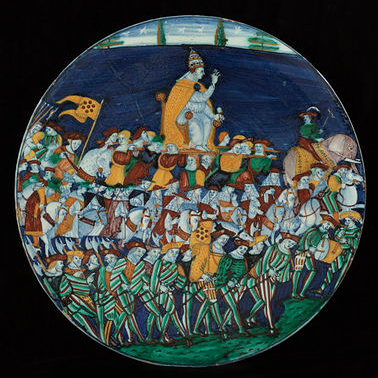
Plaque with medici-ppep visiting Florence © V&A
Medici-Pope visiting Florence 1516
© Victoria and Albert Museum, Museum number:
8928-1863

Sedia gestatoria were richly adorned , silk-covered armchairs, fastened on a suppedaneum, on each side of which were two gilded rings, through which long rods were passed allowing twelve footmen to carry the throne on their shoulders. Alongside two flagella or fans made of white ostrich feathers were traditionally carried.

These are absent, however, from an early depiction of a pope being carried around at a memorial plaque now in the V&A. The plate was probably made to commemorate the visit of the medici-Pope, Leo X, who visited Florence in 1516. Such depictions of contemporary historical events are rarely found on maiolica, rendering this a particularly interesting scene with the authentic Florentine trees in the background  and the throng of people circling the Sedia gestatoria. The plaque is exhibited at V&A in Medieval and Renaissance, room 64, case 12 and carries the number 8928 -1863.