Home » Medieval Histories » Page 51

Category: Medieval Histories

‘Medieval Histories’ offers medievalists all the news about exhibitions, books, research, archaeology, travel-tips and much more from the Medieval World

The Skull of Richard III - Leicester University ©

A Royal Diet

Richard III ate a very protein-rich diet and lots of seafood. But he also suffered from roundworm

Richard III ate a very protein-rich diet. Whether this protein came from animals or plants (beans or peas) cannot be said. However, at least a quarter of the protein came from seafood. A diet like this was typical of a late medieval nobleman, who could afford to consume expensive foods like meat, game and fish.

However, analysis of skeletons from even high-status graves in the cemetery of St. Peter’s in Leicester has shown that they ate less protein and fish than Richard III.

Further analysis has shown that Richard must have suffered from stomach troubles. Careful analysis around the gut area of Richard III resulted in finds of microscopic egg-casings from roundworms, an intestinal parasite.

Finally his teeth have been analysed. Researchers found that he must have suffered severe tooth decay, possibly from a “sweet tooth”, which he was able to please.A medieval pie

There exists at least one menu from a party, Richard III attended: his coronation on the 06.07.1483. At this feast venison, roast cygnet (swan), roast crane, roast heron, roast bittern (small heron), roast egret (another heron), sturgeon and pike were served. The banquet lasted over five hours and Richard was served on a golden plate, while Anne his wife was served on a gilt plate.

SOURCE:

Richard III. The King under the Car Park.
By Mathew Morris and Richard Buckley
Leicester University press 2013.

The intestinal parasites of King Richard III
By
Dr Piers D Mitchell et al
In: The Lancet, Volume 382, Issue 9895, Page 888, 7 September 2013

Richard III – the final act
By Amit Rai
IN: British Dental Journal 214, 415 – 417 (2013)

The Coronation of Richard III: The Extant Documents.
Ed. by Anne F. Sutton ad P.W. Hammond
Alan Sutton 1983

Massacred victims found in well at Entrains-sur-Nohain Photo © Captair

Victims of a medieval massacre found in a well in Entrains-sur-Nohain

Entrains-sur-Nohain was witness to a terrible massacre in the 8th – 10th centuries

INRAP – Institut national de recherches archaeologiques preventives – recently finished an archaeological investigation of a Roman village, Intaranum. Located in the Northwest of France at the crossroad of an important Roman network of roads it covered more than 120 ha2 of which 1000 m2 has been excavated. The archaeological investigation has uncovered a stretch of a road, a forge and a series of stone houses complete with bathing facilities equipped with hot and cold baths. These were supplied with water from deep wells.

Excavating one of these, the archaeologists found a gruesome collection of human skeletons packed in a layer measuring more than 3 metres. It is estimated that between 20 to 30 bodies were dumped into the well. Representing a collection of men, women and children the people are believed to be of civilian origin.

Even though the wells are from the antiquity, the bodies have preliminarily been dated to the period between the 8th and the 10th century. This leaves us with a number of plausible events, which may indirectly have caused the medieval massacre:

1) In 841 the sons of Louis the Pious – Lothar, Charles the Bald and Louis the German fought at Fontenoy, 25 km north of Entrains – about a days ride up North. Charles the Bald set up camp in Thury, 16 km from Entrains.

2) After 845 the Vikings arrived in the region pillaging not only Paris, Chartres and Beauvais but also Orleans and the Abbey of Saint-Benoit-sur-Loire. The massacre may have been the result of a Viking band of warriors pillaging the countryside, 30 km inland from Loire.

3) The third explanation presented is more general. The massacre may simply have been caused by one of the groups of brigands, which were known to pillage villages before the turn of the millennium, which witnessed the formation of the peace-movement, Pax Dei meant to control anarchy and widespread violence which followed in the weakening of the Carolingian power.

Future studies of the skeletons will hopefully provide a more precise date plus more information about the dead and whether they show signs of mutilations and violence. One possibility is also that the dead people were the victims of an epidemic. However, if this was the case, the question remains why they were not buried in the local cemetery, but rather dumped in a well.

SOURCE:

Au fond du puits, mystérieuse découverte à Entrains-sur-Nohain

INRAP 18.12.2013


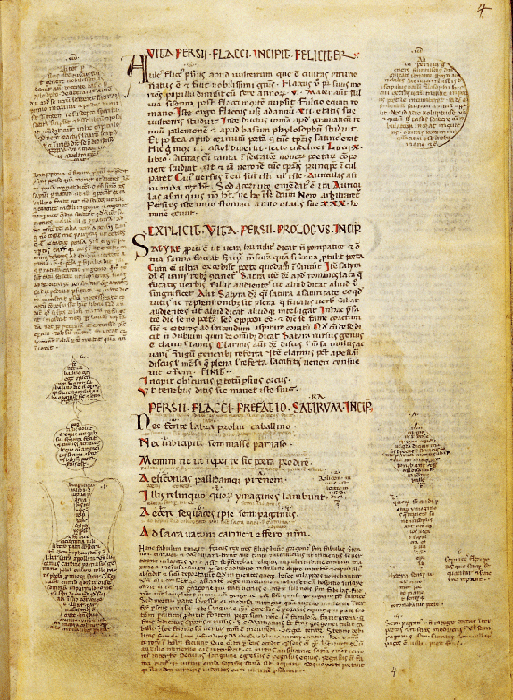
Martinellum Utrecht MS 124

University of Utrecht

Medieval Studies at The University of Utrecht, Department of History and Art History focus on Literacy and Society

The Department of History and Art History is composed of three sections: History, Art History and the Centre for Conflict Studies. The research and education programmes of the History section span the period from Classical Antiquity up to the present day. The department places a special emphasis on the history of Europe, but it also has study and research programmes dealing with the history and culture of the United States, Africa and Eastern and Western Asia.

The department’s Art History section performs research and provides education on the fine arts and architectural history from Classical Antiquity to the present day, with a special emphasis on the Middle Ages. Two research institutes at Utrecht University are involved in the study of Medieval Culture: the Research Institute for History and Art History and the Institute for Cultural Inquiry.

The research group, Medieval Culture, studies primarily medieval sources as forms of communication. Attention is paid to all the different forms – verbal, written and visual – and their interaction. The central questions are: who communicated with whom, for what reasons, and what kinds of message (intellectual, emotional, instructive, inciting, etc.) were exchanged?

PROJECTS:

The Institute has an impressive profile and a long list of important publications.

Utrecht University offers students various possibilities for studying medieval history, literature, art, music etc., at undergraduate (BA) as well as graduate (MA) level. Tutoring is provided by specialists in a variety of disciplines.

SOURCE:

Research: Medieval Culture

Capture of Jean II

Power and Influence in the Medieval World

CALL FOR PAPERS: Borderlines XVIII: Power and Influence in the Medieval and Early Modern World

We are pleased to announce the call for papers for Borderlines XVIII: Power and Influence in the Medieval and Early Modern World. This conference will be held in University College Cork, 4-6 April 2014. Proposals for both papers and panels are welcomed from postgraduate and postdoctoral researchers in the fields of both Medieval and Early Modern studies. This interdisciplinary postgraduate conference is kindly funded by the School of History, the School of English, the College of Arts, Celtic Studies and Social Sciences Graduate School, and the Forum for Medieval and Renaissance Studies in Ireland

The theme of this year’s conference will focus on the concepts of power and influence. From political thought to literary authority, the matters of power and influence, in both the Middle Ages and the Early Modern period, form a consistent presence. Their function and interpretation vary and when examining the issue of power, Foucault’s statement that “power must be analysed as something which circulates, or rather as something which only functions in the form of a chain” provides us with the starting point where we can explore the influences of power on these earlier societies.

This conference will explore and extend current perceptions of the roles of power and influence in both Medieval and Early Modern settings and invites papers that address the social, historical, literary, religious and cultural significance of these roles. We welcome papers from researchers in the fields of Anthropology, Archaeology, Codicology, Drama, Digital Humanities, Folklore, History, History of Art, Geography, Languages, Literature, Music, Paleography, Philosophy and Theology. Topics may include (but are not limited to):

• Political power and its structure
• Class system

• Physical power: combat and warfare

• Lack of power and issues of liminality

• Gender roles

• Authority in religion and religious groups

• Power: its presence and absence in society
• Literary authority

• Commerce and economics

• Place and territory

• Depictions of power and powerlessness in art and literature

Abstracts of 250 words plus a short biography for a 20-minute paper are welcomed from postgraduates (MA, PhD and Postdoctoral students), as are proposals for panels, and should be submitted by Friday 31 January 2014 to borderlinesxviii@gmail.com.

Website for Borderlines Conferences

528th Battle of Bosworth Anniversary

10.000 wish to learn about Richard III

Online course taught by scholars who brought King to light receives over 10,000 sign-ups

A new course offered for free by the University of Leicester in association with FutureLearn builds a picture of the England that Richard III inhabited in the 15th century—and comes from the scholars in archaeology, history and literature who helped uncover the monarch, whose remains were found underneath a car-park in Leicester in 2012. Over 10,000 people signed up to the first release of the course, and interest in the course has been so high that similar numbers are expected for the second release.

The course, which is already fully booked, will explore a time that saw huge upheavals, including savage dynastic warfare, shifting allegiances among a powerful aristocracy, and significant depopulation. Students will also learn about how workers become more prosperous as wages rose, and how introduction of printing transformed access to literacy and books.

Richard III
The earliest surviving portrait of Richard III

The six week course, starting on the 25th of November, will cover a different feature of Richard III’s England each week, including:

  • The Wars of the Roses and medieval warfare
  • The lives of farmers and peasants
  • Books, literacy and the arrival of print
  • Death and commemoration
  • Medieval food
  • How historians and archaeologists wove together the story of Richard III’s journey to Bosworth and burial in Leicester.

They are no entry requirements, but the course will be taught by leading academics in the field. It will entail about two hours of study a week.

“We think we’ve developed a course that will really enhance your interest and understanding of the period,” said Deirdre O’ Sullivan, Lecturer in Medieval Archaeology in the School of Archaeology and Ancient History. “As well as the way in which scholars go about identifying the questions that need to answered and bringing evidence to bear on them. There are many controversies about the period and we hope that by the end of the course you will armed with enough knowledge to formulate your own views of the credibility, or otherwise, of some of the theories around.”

The course is a MOOC—a Massive Open Online Course, delivered online to enable anyone to enjoy learning—wherever they are, and whether they are enrolled at university or not. They are offered in association with Futurelearn, which is owned by the Open University and currently launched in beta form.

FutureLearn, set up in December 2012, offers free MOOCs in partnership with 23 UK universities and three international institutions, along with the British Museum, British Library and British Council.

This MOOC is the first such course offered at the University.

“At Leicester we’ve got a lot of experience in delivering distance learning courses”, said Deirdre O’Sullivan, “We run a full set of programmes at master’s and undergraduate level, and we’ve been doing this for a long time, so we think we understand the needs of distance learning students.”

Please note that all places are currently filled on this release of the course. Applications for the next release are open; the next course will start in midsummer 2014.

SEE MORE:

See video with a presentation of the course here

These Fragments

These Fragments. Stray thoughts on the Archaeology of Early Medieval Dress and jewellery

These Fragments is a blog written by Toby Martin, who has recently acquired a post as a postdoctoral junior research fellow at the University of Oxford. The title of the project is “Origins of a European Community. Creating identity and Networkd with dress in Post-Roman Europe”


Arthurs seat at Edinburgh wikipedia

Teaching Fellowship in Late Medieval History

Teaching Fellowship in Late Medieval History

Application Address: www.ed.ac.uk/jobs
Location: Edinburgh University
Salary: £30,424 – £36,298
Contract type: Full time
Contract term: Temporary
The University of Edinburgh

The University of Edinburgh is an exciting, vibrant, research led academic community offering opportunities to work with leading international academics whose visions are shaping tomorrow’s world.

College of Humanities and Social Science
School of History, Classics and Archaeology
Teaching Fellowship in Late Medieval History
(18 months)
£30,424 – £36,298
Applications are invited from scholars of the highest calibre with teaching experience in any aspect of the late European Middle Ages (c.1200-1450). You will have expertise in any area of late Middle Ages, but preference will be given to those with knowledge in European history.
This post is tenable from January 2014 on a full time, fixed term basis for eighteen months.
Apply online, view further details or browse more jobs at our website. www.ed.ac.uk/jobs

Closing date: 13 November 2013.
Committed to Equality and Diversity, The University of Edinburgh is a charitable body, registered in Scotland, with registration number SC005336.


CENDARI Visiting Research Fellowships

Call For Applications For The CENDARI Visiting Research Fellowships (2014)

The Call for Applications to the CENDARI Visiting Research Fellowships programme for 2014 is now open and the closing date for receipt of applications is the 9th December 2013.

The following institutions will offer fellowships for 2014 on a competitive basis:

Trinity College Dublin, Ireland

King’s College London, UK

National Library of the Czech Republic, Czech Republic

Göttingen Centre for Digital Humanities (GCDH), University of Göttingen, Germany

University of Stuttgart and Bibliothek für Zeitgeschichte, Germany

The CENDARI fellowships are funded for between 6 and 12 weeks.

The Harry Potter Generation

Boy wizards, elves and feisty medieval queens fighting for an iron throne inspires students to enroll at the Medieval Studies Programme, tells new director

Tales of a boy wizard and stories about elves and world-shattering  fights about an uncomfortable iron throne might have something to do with an increased flow of students interested in medieval studies, tells the new director for the Medieval and Renaissance Studies Program at the University of Ottawa, Cristina Perissinotto, to the The Ottawa Citizen. While enrolment in the university’s small interdisciplinary program has usually hovered around 40 students, last year there were 58, she said. This represents a growth of more than 45%. The reason for the spike isn’t clear, Perissinotto said to journalist Neco Cockburn, but she suspects that massively popular books, movies and TV series could be playing a role.

‘They’re at that age that when they started to become interested in reading — serious books, not children’s books — Harry Potter was around. These stories come out, with beautiful packaging, and people start looking at them and being fascinated by them, and then it becomes one of those passions. … It creates a point of entry, but then they want to know more,’ she said to the newspaper.

The Harry Potter generation, however, who started out reading about  the exploits on the Hogwarts School of Witchcraft  in 1997 have already graduated. More likely the inspiration stems from the filming of Tolkiens trilogy from 2001 and the later surge in series like Henry VIII, the Borgias and not least the Game of Thrones, which Perissinotto also mentions. This observation coincides with some remarks, which were phrased by the acclaimed medievalist, Dame Janet Nelson in an interview in 2008. In the interview the professor with a 38 year career at King’s College in London said that she had noticed that undergraduates studying modern history generally claimed that they had been inspired by watching films and TV. “But that doesn’t so often happen with medieval history because there just isn’t so much available”, she said adding that there had been some programs and that she did not think there was “any reason why medieval history shouldn’t join in this flourishing [area]”.

quidditch-team-preparing for Ottawa-University - medieval Histories
Quidditch Team practising for Ottawa University

A few days ago (18.10.2013) the University opened its doors and so did the Medieval Studies programme with a bonanza of lectures and fun celebrating modern medievalism. Andrew Taylor, the vice dean of undergraduate studies in the faculty of arts gave a lecture on “Harry Potter, or Game of Thrones….What were the Middle Ages really like?”. In it he tried to decipher the “real Middle Ages” and tell a bit about some of the misconceptions of the era. Later parents and students were treated to a session “Telling stories from the Middle Ages and the Renaissance”. Here nationally acclaimed novelist and storyteller Marie Bilodeau, of the Kymeras Group, gave a public performance for students and parents visiting the University of Ottawa, while weaving myths and stories form the Middle Ages and the Renaissance, adapting them to a to a modern sensibility. Finally the day ended with “The Society for Creative Anachronism” which paid an extraordinary visit to the University of Ottawa Open House. A variety of medieval and renaissance Lords and peasants showed up in period attire to demonstrate fencing and teach any willing guests a few period dances.

Some might consider these activities daring in an academic context. To Ottawa University, however, this is not something new. Already some years ago the University established a Quidditch team, which plays with broomsticks and all the other paraphernalia both in the Canada Tournament and on the world stage (See video here)

Some high school students, who attended the lecture on Friday said to Neco Cuckburn “that they had already been interested in history outside the fictional series, though they acknowledged that Potter’s adventures in particular may have piqued their interest or turned it in new directions. ‘I wasn’t really interested in the whole fantasy or even medieval stuff, and then I started reading books like Lord of the Rings or Harry Potter and then I was drawn to it because people who wrote the books wrote them so well that it made me interested,’ said Grace Macfarlane, a Grade 12 student at Holy Trinity Catholic School” to Neco Cockburn.


SOURCE:

Harry Potter, Game of Thrones possibly behind surge in interest in medieval studies at uOttawa
by Neco Cockburn – twitter.com/NecoCockburn

Making History: Interview with Dame Janet Nelson 2008

See video presenting the University of Ottawa Quidditch team 

Read a presentation of the Medieval and Renaissance Studies Program at the University of Ottawa, Canada

Tabaret Hall -Univerity of Ottawa - Medieval Histories

Medieval and Renaissance Studies at the University of Ottawa

Medieval and Renaissance Studies at the University of Ottawa

The major and minor in medieval and Renaissance studies are interdisciplinary programs whose multi-faceted approach helps students better understand the complexity and richness of medieval civilization. In addition to courses that provide an introduction to medieval civilization, the programs include a number of courses in history, classical studies, music, English, linguistics, English and French literatures and other disciplines. Focus is on Medieval Studies more than Medieval History.

THE UNIVERSITY OFFERS

RESEARCH FIELDS:

  • Late Antiquity to renaissance literature, religion and philosophy
  • Biblical criticism and modern topics
  • History of the book from the Middle Sges to the Renaissance
  • Production and social use of writing
  • Rhetoric and education from late Antiquity to the Renaissance
  • Narrative and historiography from Late Antiquity to the Modern era
  • History of reading
  • Manuscript culture
  • Women writers
  • Medieval and modern theatre
  • History of religious institutions and universities

READ MORE:

Medieval and Renaissance Studies Program at the University of Ottawa / Programme d’Études médiévales et de la Renaissance à l’Université d’Ottawa


Promotional Pamphlet

The Medieval and renaissance Studies program have a Facebook page

The Medieval Studies Student Association/ L’Association Étudiante des Études Médiévale – University of Ottawa/ Université d’Ottawa has a facebook group


Mummers. Source: Bodleian Library MS. Bodl. 264 fol 22r/Wikipedia

Assistant Professor of Medieval Literature and Culture – University of Massachusetts Boston

Assistant Professor of Medieval Literature and Culture – University of Massachusetts Boston

Job Description:
Tenure track position, beginning September 1, 2014, for a specialist in Medieval Literature and Culture.  Strong candidates will possess a background in the history of the English language, global/comparative studies, history of the book, and/or digital humanities. Please describe secondary and interdisciplinary areas of research and teaching expertise in your letter of application.  The position carries a 2/2 teaching load, which includes general education courses, English major courses—both large lecture classes and discussion-based classes—and graduate seminars.  UMass Boston is a lively urban research university with a large and dynamic undergraduate English major, over 100 English master’s students, an MFA program for fiction and poetry, and the most diverse student body in New England.

Requirements:
Minimum Requirements: Ph.D. in English or related field (candidates must have Ph.D. in hand by August 2014).

Additional Information:
UMass Boston is an Affirmative Action, Equal Opportunity, Title IX employer.

Application Instructions:
Applications must be received by November 15.  Submit a cover letter, CV, letters of recommendation, and a writing sample of no more than 20 pages online.  Dossiers of letters of recommendation must be emailed directly to english.recruitment@umb.edu to the attention of Prof. Cheryl Nixon, Chair, Department of English.

Please share this job posting with any potential applicants.  The full details are available here: http://umb.interviewexchange.com/jobofferdetails.jsp?JOBID=43654&CNTRNO=1&TSTMP=1382152288761.

Assistant Professor of Medieval European History (600 to 1500) – The University of Southern Mississippi

Assistant Professor of Medieval European History (600 to 1500) – The University of Southern Mississippi

The University of Southern Mississippi invites applicants for a full-time, nine-month, tenure-track faculty position as an Assistant Professor of Medieval European History (600 to 1500) in the Department of History in the College of Arts and Letters to begin in Fall 2014.  The area of specialization is open.  The appointment is located at Southern Miss’s Hattiesburg campus.  The successful candidate will be expected to teach a 3/3 load, including world history surveys and upper-level and graduate courses in field of expertise, and to direct M.A. theses in medieval history and serve on doctoral committees.  The successful candidate will also be expected to pursue an active research agenda and contribute to the department’s service obligations.  Minimum qualifications are a doctorate in history by time of appointment and the promise of excellence in teaching, scholarship, and service.  Salary is commensurate with qualifications and experience.  Applicants must complete an online application at https://jobs.usm.edu, including the submission of a letter of application, curriculum vitae, graduate transcripts, three letters of recommendation, teaching portfolio, and an article/chapter length writing sample.

Applications must be complete by Nov. 4, 2013, to ensure full consideration.

Founded in 1910, The University of Southern Mississippi is a comprehensive doctoral and research-extensive university fulfilling its mission of being a leading university in engaging and empowering individuals to transform lives and communities. The University of Southern Mississippi, which enrolls nearly 17,000 students each year, is the only dual-campus university in Mississippi with campuses in Hattiesburg and Long Beach. Six additional research sites are located on the Mississippi Gulf Coast and in Meridian.  Learn more at www.usm.edu.  The Department of History’s faculty includes award-winning authors and teachers. The department offers bachelors, masters, and doctoral degrees.  Students have the opportunity to explore the histories of North America (with a special emphasis on the American South), Europe, Latin America, Asia, and Africa. We are a leading institution for the study of War & Society and are a regional leader in preparing students to teach history.  Learn more at: http://www.usm.edu/history

As an Affirmative Action/Equal Employment Opportunity employer/Americans with Disabilities Act institution, The University of Southern Mississippi encourages minorities, women, veterans, and persons with disabilities to apply.

Contact:

Questions should be directed to: Dr. Westley Follett, Chair, Medieval Europe Search, Department of History, 730 East Beach Blvd., The University of Southern Mississippi, Long Beach, MS  39560; Phone: 228-214-3360, Email: westley.follett@usm.edu.


Website:     http://www.usm.edu/history

Primary Category:       Medieval and Byzantine History / Studies

Secondary Categories:        European History / Studies

Posting Date:      10/06/2013

Closing Date       01/30/2014

Medieval University

Assistant Professor in Late Antique or Early Medieval History – Alabama

Assistant Professor in Late Antique or Early Medieval History – Alabama

The Department of History of the University of Alabama invites applications for a tenure-track position at the rank of Assistant Professor in Late Antique or Early Medieval history. The successful candidate will be expected to teach the first half of the department’s Western Civilization survey, as well as upper-level and graduate courses in his/her area of specialty. The Department and University emphasize excellence in teaching as well as scholarship. Normal teaching load is two courses per semester. Ph.D. must be in hand by time of appointment. To apply, go to http://facultyjobs.ua.edu and complete the online application. Attach a letter of application, c.v., and writing sample (article or chapter). Please arrange to have three letters of recommendation sent to James Mixson, Chair, Late Antique/Early Medieval Search Committee, Department of History, University of Alabama, Box 870212, Tuscaloosa, AL 35487-0212. Please direct any inquiries to jmixson@ua.edu. Review of applications will begin on November 15 and continue until the position is filled. The University of Alabama, the flagship university of the state of Alabama, is an Equal Opportunity/Affirmative Action employer, and actively seeks diversity among its employees.

Contact:

James D. Mixson

Chair, Late Antique/Early Medieval Search Commitee

Department of History

University of Alabama

P.O. Box 870212

Tuscaloosa, AL 35487

jmixson@ua.edu

(205) 348-7100

Website:     www.history.ua.edu

Primary Category:       None

Secondary Categories:        Ancient History

Medieval and Byzantine History / Studies

Posting Date:      10/04/2013

Closing Date       03/01/2014