Fourteenth-century Barcelona was home to a number of flamboyant artistic workshops producing cartoon-like altarpieces for a wider market.

Fourteenth-century Barcelona was home to a number of flamboyant artistic workshops producing cartoon-like altarpieces for a wider market.

 Altenberg Madonna Enters the Städel Museum: A Landmark Acquisition
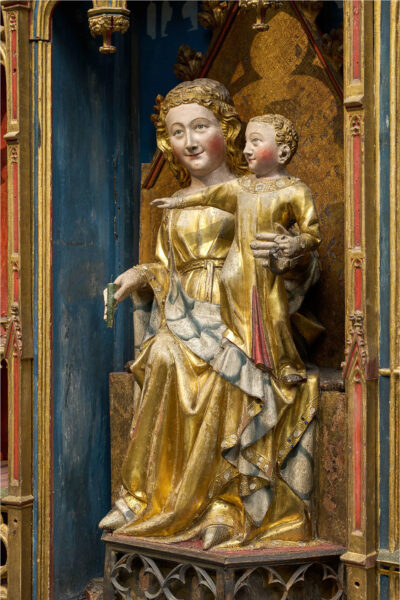
This morning, the Städel Museum announced what can rightly be described as a watershed moment for the study and appreciation of medieval art in Germany: the acquisition of the Madonna and Child Enthroned, known as the Altenberg Madonna. Dating from around 1320–1330, the sculpture entered the museum’s collection through the joint support of the Ernst von Siemens Art Foundation, the Städelscher Museums-Verein, and the Kulturstiftung der Länder.
With the acquisition of the Altenberg Madonna—made possible through the generous support of leading German cultural foundations—the Städel Museum in Frankfurt achieves the long-awaited reunification of the Altenberg Altar. This exceptional 14th-century Gothic sculpture thus ranks among the most significant acquisitions in the museum’s history.
Considered one of the supreme masterpieces of German Gothic sculpture and among the earliest surviving works of 14th-century Cologne production, the Altenberg Madonna is listed as cultural property of national importance and is therefore subject to strict export protection.
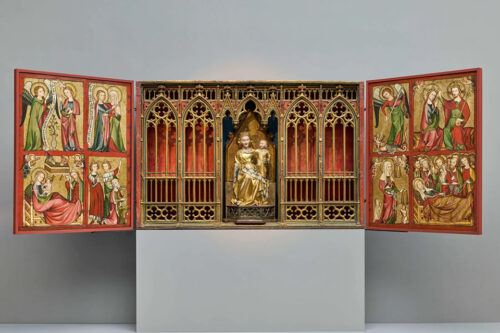 The sculpture was originally created for the Altenberg Altar, commissioned for the abbey church of the Premonstratensian convent of Altenberg an der Lahn, near Wetzlar in Hesse. For more than a century, the Städel Museum has preserved the painted wings of this extraordinary polyptych—among the oldest examples of German panel painting in its collection. The altar’s central shrine has long been held on permanent loan from the Braunfels Castle Museum. With the acquisition of the Madonna, once positioned at the very heart of the ensemble, the Altenberg Altar can now be fully reassembled and permanently presented to the public for the first time in its history.
The sculpture’s recent history reflects a prolonged period in private ownership. From the late 1920s onward, the Altenberg Madonna was located in southern Germany and, from 1981, remained on permanent loan to the Bayerisches Nationalmuseum in Munich. Its transfer to the Städel thus represents not only a major enrichment of the museum’s collection, but also a symbolic and historical return of the work to its original artistic and narrative context.
Philipp Demandt, Director of the Städel Museum, remarked: “After one hundred years, the celebrated Altenberg Madonna has returned to its rightful place at the heart of the altar—a truly memorable moment in the history of the Städel. This exceptional acquisition was made possible by the foresight of the owners and the extraordinary commitment of our supporters. I extend my sincere thanks to the Ernst von Siemens Art Foundation, the board and members of our supporting association, and the Kulturstiftung der Länder.”
The Altenberg Altar occupies a distinguished place in the history of European sacred art. From the late 13th century onward, sculpted and painted altarpieces became central fixtures in churches across Latin Europe, fostering close collaboration between painters and sculptors. Particularly north of the Alps, altars with movable wings were developed to accommodate changing liturgical requirements throughout the church calendar. Created around 1330, the Altenberg Altar is among the earliest surviving examples of this innovative format.
On weekdays, the altar displayed scenes from the Passion of Christ against a dark ground. Gradual opening revealed the central shrine containing the Altenberg Madonna, surrounded by the abbey’s relics. On Sundays, a partial opening presented the Virgin flanked by episodes from her life. This sophisticated iconographic program emphasized Mary’s role as patroness of both church and convent, reflecting the significance of Marian devotion in the spiritual and political life of the region.
The abbey of Altenberg maintained close ties to the ruling family of the landgraves of Hesse and Thuringia. After the death of Ludwig IV of Thuringia, Saint Elizabeth of Thuringia entrusted her youngest daughter, Gertrude, to the abbey. Gertrude later became abbess and shaped its fortunes for decades, while the presence of Saint Elizabeth’s relics established Altenberg—alongside Marburg—as a major center of her veneration.
Artistically, the Altenberg Madonna belongs to the well-known type of enthroned Virgins with the standing Christ Child, developed in Cologne under strong French influence. Related examples are preserved in numerous collections, including the Liebieghaus Skulpturensammlung in Frankfurt. The Altenberg Madonna, however, is distinguished by its extraordinary sculptural refinement and the exceptional preservation of its original polychromy—an exceedingly rare survival for wooden sculpture of this period.
Mary is shown as a youthful figure with a gentle, animated smile, seated on a throne with a slender cushion and a high back crowned by a pointed, ornamental gable. Her feet rest upon a polygonal base adorned with tracery. In her right hand she once held a lily, symbol of her virginity and emblem of her queenship, while her left supports the Christ Child, who stands partly on her thigh and partly on the throne. The Child’s gesture—reaching toward the lost lily while clutching a bird that pecks painfully at his finger—subtly prefigures the Passion.
The sculpture’s splendor is further enhanced by the gilded garments of both figures, enriched with glass insets imitating precious stones, and by the original presence of a crown. Mary’s gold mantle, lined with ermine, underscores her role as Queen of Heaven, while the lavishly decorated throne affirms the sacred and regal character of the image.
Monastic Culture and Provenance
The Altenberg Madonna and its altar also stand as eloquent testimony to the artistic and spiritual achievements of medieval female monastic culture. Within a society dominated by male hierarchies, the Premonstratensian nuns of Altenberg fostered a remarkably sophisticated theological and artistic environment, giving rise to one of the most distinguished sacred ensembles of its time.
The sculpture’s provenance is comprehensively documented. Following the secularization of the abbey in 1803, the Madonna passed into the possession of the princes of Solms-Braunfels and was sold in 1916 to Munich art dealer A. S. Drey. By the late 1920s, it entered the collection of Julius Böhler, remaining in family ownership until its acquisition by the Städel Museum.
Martin Hoernes, Secretary General of the Ernst von Siemens Art Foundation, commented: “The Altenberg Madonna is a captivating and remarkably early example of Cologne’s medieval sculpture. Preserving cultural heritage for present and future generations lies at the heart of our mission. Bringing this work—from Cologne via Altenberg to Frankfurt—to the Städel Museum fulfills our founder Ernst von Siemens’s conviction that works of art should be placed where they can be experienced by the widest possible audience.”
The Altenberg Madonna © Städel Museum and Norbert Miguletz
PRESS RELEASE: Altenberg Madonna acquired for the Städel
READ ALSO:
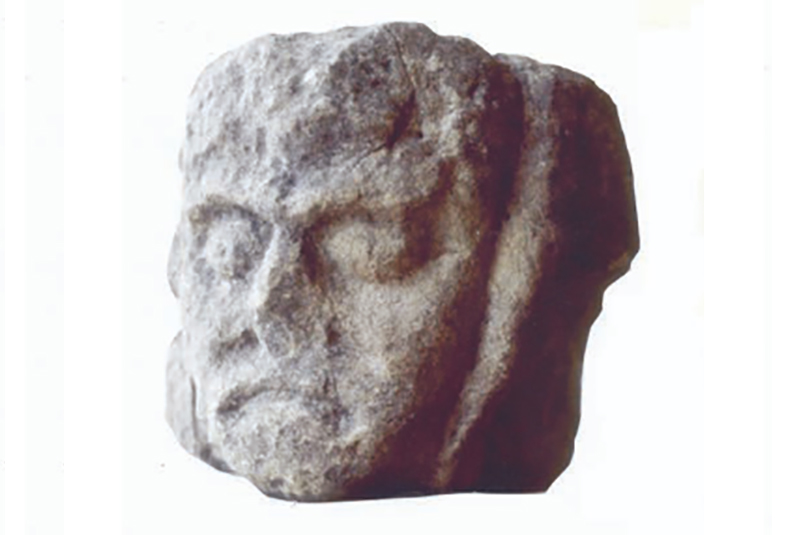
When Angus’s father died c. 1250, an Irish bard composed a praise poem petitioning the son to pay his father’s debt. The poem offers a vivid account of the cultural inventory of one of the Sea Kings.

Since 2012, archaeologists and scientists have been poking through 1300 bones, the remains of kings, queens and bishops laid to rest in the mortuary chests in Winchester Cathedral.

Burgundy, 450-535.Politics and religion in the Gibichung Province.
By Ian Wood
Series: Saggi di Storia Antica vol 38
“L’Erma” di Bretschneider 2026
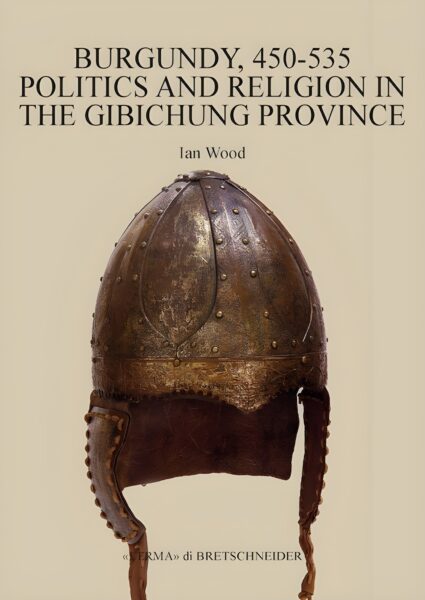 This book examines the early medieval Burgundian polity, which attempted in the 5th and 6th centuries to establish itself less than a successor kingdom and more as a Roman province; and did not succeed.
In the final years of the Western Roman Empire and during the following half-century, the valleys of the Rhône and Saône were governed by members of a royal Burgundian family, the Gibichungs. They ruled not as barbarian kings but as Roman magistri militum. Their prominence derived from their association with the magister militum praesentalis Ricimer, and they operated in close cooperation with members of the late Roman senatorial aristocracy, including Sidonius Apollinaris and some of his contemporaries.
This region under their control was a centre of religious and cultural life, distinguished by the works of Sidonius, Claudianus Mamertus, Faustus of Riez, and Avitus of Vienne. The interaction of politics and religion culminated in the foundation of the monastery of Agaune, a major episcopal gathering at Épaone, and the promulgation of an important body of legislation issued by King Sigismund, before collapsing dramatically in the wake of a political crisis caused by the ruler himself. The failure of the Gibichung state in AD 534 marked the end of a remarkable experiment in governmental continuity in post-Roman Gaul.
This book is written by one of the most authoritative scholars of the Early Middle Ages, Ian Wood, Professor Emeritus at the University of Leeds. Renowned for his long-standing engagement with the cultural history and historical anthropology of the Early Middle Ages, Wood here offers a long-awaited full account of events in a region that, during the fifth and early sixth centuries, became entangled in conflicts between the Romans, the Huns, the Franks, the Visigoths, and finally the Ostrogoths. None of these powers appears to have been willing to allow this political gatekeeper to establish itself permanently at the threshold of one of the principal Alpine passes through what is now western Switzerland. Not least, perhaps, because the so-called Burgundian realm represented a genuine experiment in the fusion of Roman and Germanic cultural forms. The realm—if it was ever truly a kingdom, which this book argues it was not—came to an end when it was absorbed into the Frankish Empire in AD 534. As Ian Wood states in his introduction, this is therefore a history written “primarily through the eyes of late Roman aristocrats and those who interacted with them, and not through the perspective of the Völkerwanderung and the Germanic kingdoms”.
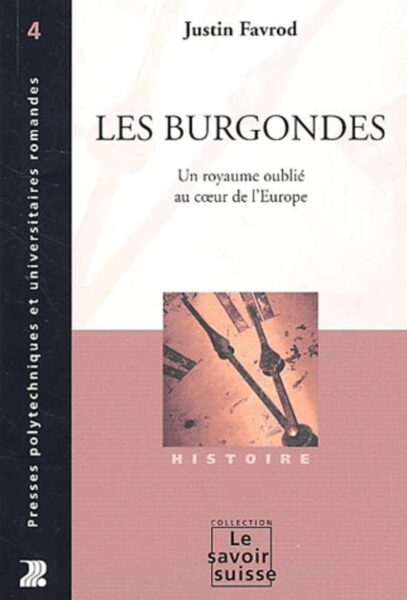 Les Burgondes: un royaume oublié au coeur de l’Europe
Favrod, Justin
Pu Polytechnique, Lausanne 2002
French Edition.
The Burgundians, the people of the Nibelungen, left the Rhine at the command of the Romans. They settled around Geneva, where their kings were charged with ensuring military control of the Alpine passes. However, between the fifth and sixth centuries, the Empire they were meant to defend collapsed. In a political movement that transformed Europe, the Burgundian kingdom expanded across parts of what are now France and French-speaking Switzerland and began to exercise independence. This is a fascinating and little-known period, in which the author, through a critical analysis of historical knowledge and a remarkable contribution of his own research, describes the coexistence in this first “Burgundy” of a people from the North and the Gallo-Romans.
Interethnic harmony was regulated by a law issued by King Gundobad. Gradually, the linguistic boundary between French and German took shape and has endured to the present day. Here the past takes on the face of a royal family whose tribulations—marked by bloodshed, wisdom or fury, success or disaster—are inscribed in the broader transition from Antiquity to the Middle Ages
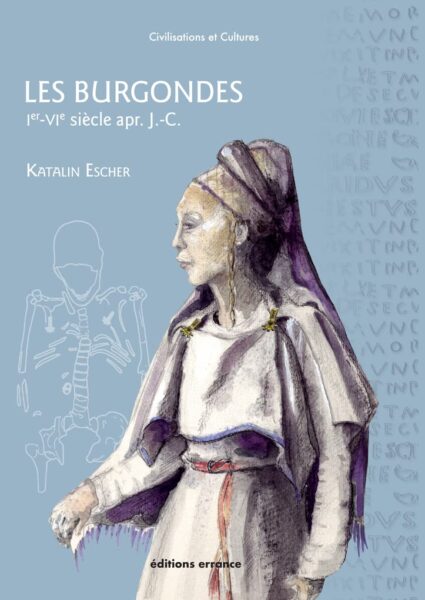 Les Burgondes: Ier – VIe siècles apr. J.-C.
By Katalin Escher
Errance, Paris 2021
French edition
A Germanic people originating in what is now Poland, later settled on the Rhine and then in the Rhône valley of Gaul, the Burgundians inscribed their name both in the geography of Europe—where a “Burgundy” still exists today as the heir to several kingdoms—and in its great epic traditions, such as that of the Nibelungen. They were among the principal actors in the period of the Great Invasions in the West. This book takes stock of current knowledge concerning this people.
Drawing on ancient sources, it reconstructs the three major phases of Burgundian history: a kind of “preface” extending from their origins to their settlement on the Rhine (established by no later than the beginning of the fifth century); the “first” Rhine kingdom, whose destruction by the Huns in 436 inspired the Nibelungen cycle and certain Scandinavian sagas; and finally the “second” Rhône kingdom, which marked the apogee of Burgundian power before being incorporated into the Frankish kingdom in 534. For each of these periods, the archaeological remains that constitute the material traces of the Burgundian people are presented, with particular emphasis on the second kingdom. Consideration is also given to linguistic and toponymic evidence.
This study makes it possible to sketch as faithful a portrait as possible of the Burgundian people, who, at the end of their historical trajectory, became a constituent element of the French and Swiss populations. At the same time, it highlights the importance of their interactions with other major actors of Late Antiquity: the Huns, destroyers of the first kingdom; the Goths; the Alamanni; the Alans; and the late Roman world, which the second kingdom both extended and replaced. The composite culture of Burgundian Gaul in the fifth and sixth centuries, shaped by these various influences, reflects a period of intense interaction and the formation of new identities.
Vase of St. Martin at St. Maurice d’Agaune. Source: Wikipedia.The myth is, the vases was gifted to the Monastry at Agaune by St. Martin of Tours. Likely, hoever it was a gift from Sigismund while king to his new abbey. The core of the vase is from the 2. century BC, while the setting is likely to have been worked at the end of the 5th century. Thus, the vase illustrates the point made by Ian Wood that the Burgundian politi was a cultural patchwork.
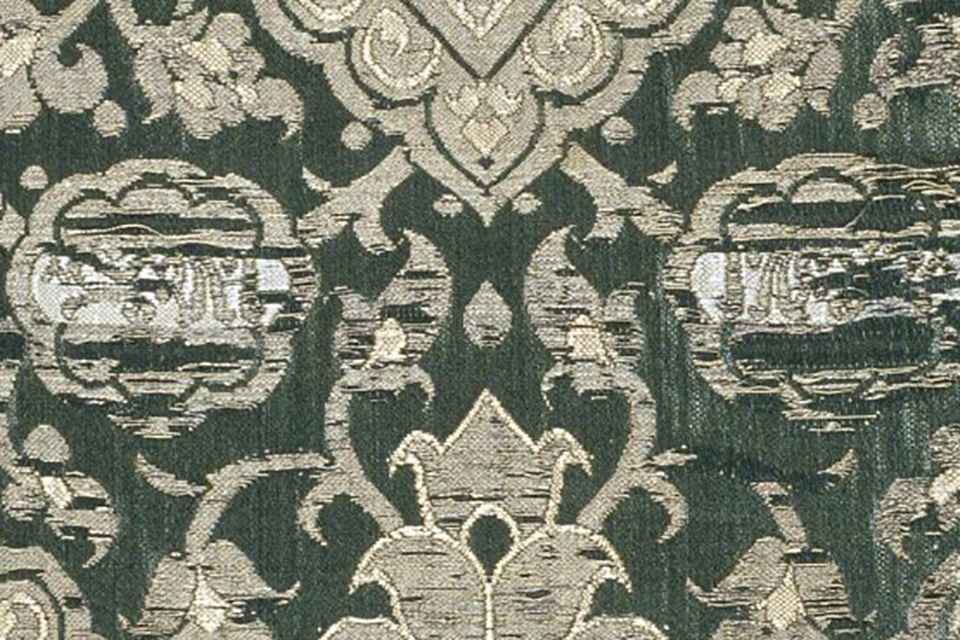
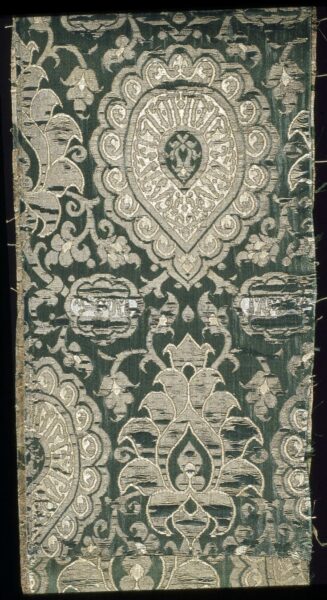
In the Victoria & Albert Museum, a long rectangular strip of silk tapestry from the 15th century, decorated with tall palmettes, lobed pear-shaped medallions with inscriptions in their borders, and lobed cartouches containing shorter, horizontal inscriptions.
This strip of silk was used as the orphrey of an ecclesiastical vestment, and is of a type of Mamluk textiles which was very popular in Europe in the later medieval period. They must have been imported from the eastern Mediterranean.
The pear-shaped medallions are inscribed with the phrase ‘ ‘izz li-mawlana al-malik’, meaning ‘glory to our lord the king’. The smaller medallions, which have eight lobes, are inscribed with the word ‘al-Ashraf’ (meaning ‘Exalted’). This was one of the titles used by Sultan Qa’itbay (1468-1496), but that does not necessarily mean that this textile was therefore made during that Sultan’s reign.
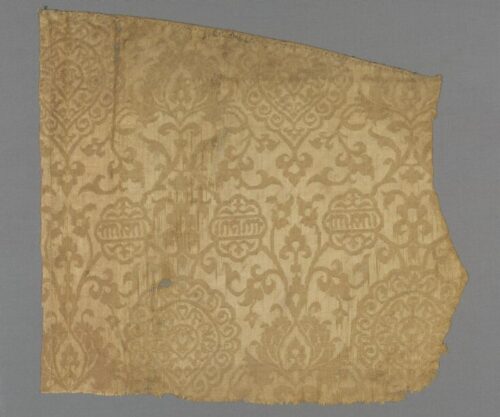
In the later Middle Ages, silk in Europe was no longer an unattainable luxury imported at prohibitive cost from China. Instead, it had become an attainable luxury, desired by merchants and lesser nobles eager to parade what had formerly been confined to ecclesiastical and elite vestments. Although the main supplier was Byzantium, silks were also produced and exported from the Levant, especially Syria and Egypt. Soon, from the mid-12th century onward, silks were also woven in Lucca, Venice, and other North Italian cities.
The demand for these middle-quality products was first detected in Italy, fostered by the Crusades and the Latin settlements in the Levant. Soon, however, they were also praised in chivalric literature. Later, in 1260, the Mongols entered the scene, once again providing oriental silks imported from the Far East. These products were known as panni tartarici (“Tatar cloth”). Meanwhile, designers and artisans moved back and forth along the Silk Road.
Some of these textiles were adorned with Arabic tiraz inscriptions referencing the ruler. Originally quite specific, these inscriptions became fashionable, merely conventional, and ultimately unidentifiable. Indeed, it appears that they had little meaning beyond signalling Western fascination with all things “oriental.” Especially favoured were roundels or medallions, a motif adopted by Italian craftsmen and weavers from Tatar cloths. This made it difficult for scribes to inventory such silks accurately, as Italian products were considered cheaper than the “real” thing. From the evidence adduced above, it is nevertheless clear that oriental silks originating in Alexandria and Damascus were regarded as prestigious objects.Thus, the English royal court continued in the 15th century to show a clear preference for silks bearing authentic oriental names. In general, though, silks marketed in Europe during the 15th century, became increasingly Italian in origin.
This shift was probably due in part to the introduction of technical innovations, such as the silk-throwing circular machine, first attested in Lucca in 1330. Another explanation may lie in the upheavals in the Levant following the Turkish and Islamic wars and the fall of Constantinople in 1453.
Detail of silk panel from Syria or Egypt in the 15th century © Victoria and Albert Museum, London, CC-BY-SA
Oriental Silks go West: A declining trade in the Later Middle Ages.
By David Jacoby
In: Islamic artefacts in the Mediterranean world : trade, gift exchange and artistic transfer
Ed by Catarina Schmidt et al.
Collana del Kunsthistorisches Institut in Florenz, Max-Planck-Institut, vol 15 (2011)
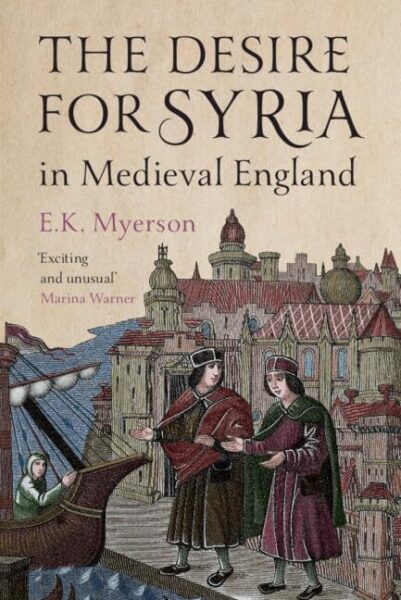
The Desire for Syria in Medieval England
by E. K. Myerson
Cambridge University Press 2025
 This book explores how desire for Syrian luxury goods reshaped English culture in the late Middle Ages. Focusing on the circulation of commodities known collectively as Syriana—sweet wines, spices, silks, jewels, and minerals—it shows how international trade connected England to the eastern Mediterranean and embedded the Levant deeply within English imagination, material life, and systems of meaning.
The study is anchored in a dramatic historical event. In June 1458, two English merchant ships returning from the Levant were attacked by pirates off the coast of Malta. Their captain, the Bristol merchant Robert Sturmy, was killed, and a cargo worth an extraordinary sum was seized. Recovered through legal records and inventories, this lost shipment provides a point of entry into a wider history of commerce, violence, longing, and cultural encounter.
Using this incident as a lens, the book reconstructs the afterlives of Syrian goods in medieval England. These commodities, once associated with the Holy Land and later traded through the markets of the Mamluk Empire, carried layered meanings: sacred, medicinal, aesthetic, and erotic. They circulated not only through ports and marketplaces, but also through texts, images, recipes, churches, workshops, and domestic spaces.
Drawing on archival research alongside art history, literary analysis, and theoretical perspectives, the book argues that Syriana functioned as a powerful cultural category. It shaped English art and language, transformed practices of medicine, cuisine, craft, and religion, and revealed an ambivalent relationship to the East—marked by fascination, appropriation, and desire as much as by fear or hostility.
By following these goods and the fantasies attached to them, the book reframes medieval England as a place formed through global entanglements. It shows how commerce and imagination worked together to produce enduring ideas about luxury, difference, and power—ideas whose legacies continue to shape the present.
E. K. Myerson is an artist, writer, and curator, currently studying at the Royal College of Art. His academic and creative writing has appeared in publications including GLQ, The TLS, Wasafiri Magazine, New Medieval Literatures, postmedieval, and Wellcome Collection Stories. He received his PhD in medieval literature from Birkbeck College in 2022, and have held postdoctoral fellowships at the Wellcome Trust / ISSF Fund, the Parker Library, and Emmanuel College, Cambridge.
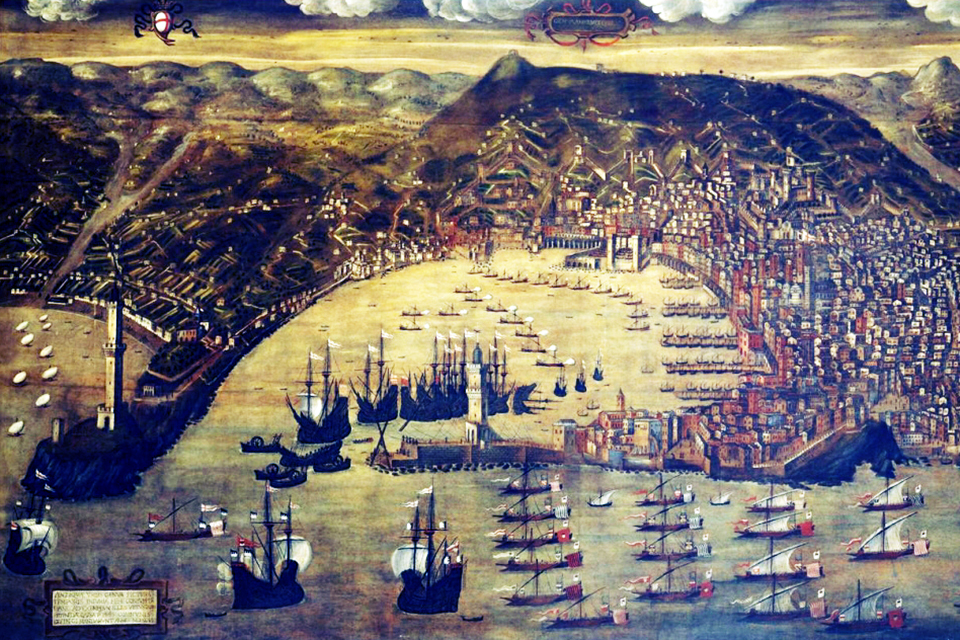
Port of Genoa 1481. By Christoforo Grassi. © Galata Maritime Museum. Source: Wikipedia
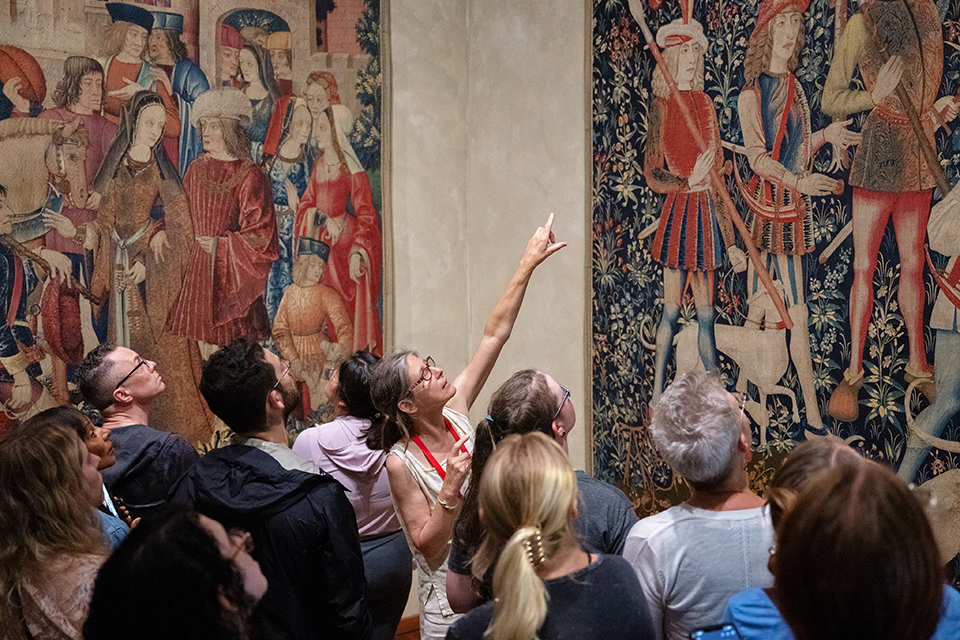
Fluid and queer sex is featured in a new medieval exhibition at the Met Cloisters in New York during winter 2025-26
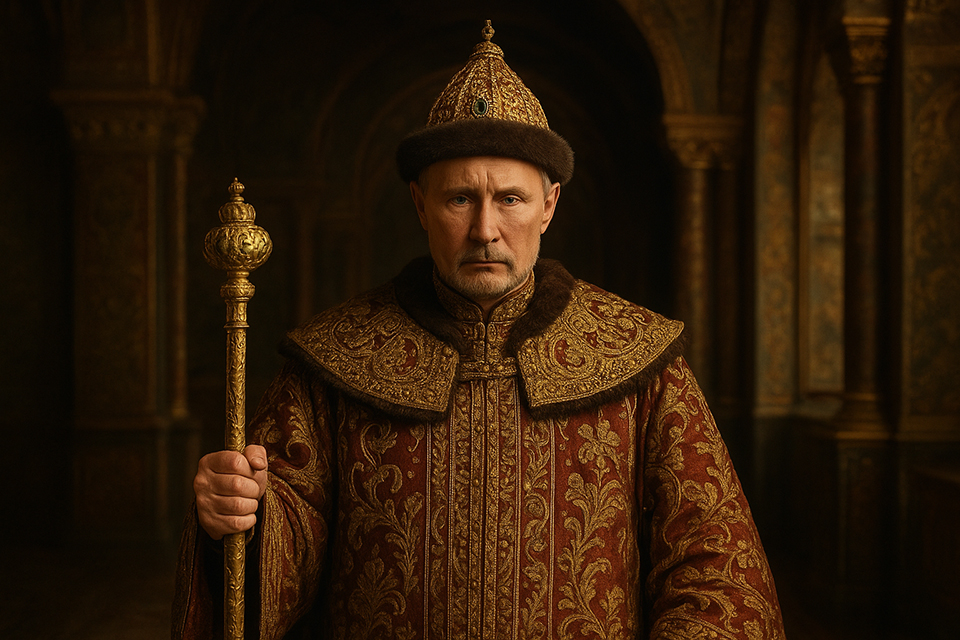
“Mr. Putin also demanded guarantees that Russian should be an official language in Ukraine, and that security should be established to allow the Russian Orthodox Church to be reinstated as the leader of the Orthodox Church in Ukraine”, wrote New York Times in a reference to Putin’s and Trump’s negotations in Alaska.
In truth, these demands appear downright bizarre. Consider the context: Russia has waged a war of aggression that, so far, has cost around a million Russian lives or ruined their health, without securing any meaningful territorial gains. And yet, Putin shows up in Alaska with demands that, beyond territorial concerns, peace should also reinstate the Russian language and the Russian Orthodox Church as national cultural focal points in the future Ukraine. Why is this so important to him? What is this war really about? Generally, three explanations are put forward:
The first type of explanation is individual-oriented. Here we note that Putin, for one reason or another, appears as a character deviant. Maybe he is also ill (Parkinson’s has been mentioned). What we have witnessed since 2014, when Crimea was annexed, really looks from the outside like the work of a madman. For who else but psychopaths with delusions of grandeur start a war whose main manifestation is terror-bombings of civilians in Kyiv and the rest of Ukraine? And where more than a million Russian soldiers have ended up dead or maimed in the meat grinder of the battlefield since 2022?
Further on, commentators have attempted to dig deeper into Putin’s personal history. He was born in 1952 in Leningrad as the youngest son of a factory worker and soldier. His childhood home was undoubtedly also marked by a couple of other circumstances, namely that his grandfather had been cook for both Stalin and Lenin, while his mother was a dedicated churchgoer and believer. There must have been a certain “cognitive dissonance” in that home. In addition, it would have been marked by the stories of one of his two brothers, who died of hunger in Leningrad in 1942. The Revolution and the war would have been ghosts that haunted his childhood and youth. After school and university, where he studied law and economics, he was recruited in 1975 to the KGB. He then served in the GDR as liaison officer until 1989. After the coup against Gorbachev, however, he changed horses in midstream to support the restoration of the defunct Russia. In 1998 he was appointed head of the FSB (the KGB’s successor), until he was elected president in 2000. Might this be enough of an explication? Somehow, it does not quite suffice to explain the odd demands quoted here. We need more context
Although the sources are sparse, there is a straight line from Putin’s deeply felt regret over the collapse of the Soviet Union to his self-proclaimed preoccupation with Russia’s medieval history and the Russian Orthodox Church. He has himself mentioned this as a background for his political positioning.
This preoccupation with the Middle Ages is clearly linked to his desire to re-establish the world order that prevailed before the invention of the “nation” in the 1500s as the primary political “actor”. In short, the idea of a Europe of imagined communities configured as nations consolidated during the 15th and 16th centuries, to be finally codified in 1648 in Westphalia. Since then, the idea spread in a way that made it seem “natural.” Today in the Western world we no longer think in terms of empires, but rather nations shaped by the basic dictum: cuius regio, eius religio, with our addition, eius lex. The original dictum was confirmed in 1555 in Augsburg, though first formulated in 1582. It means: “Each kingdom, its religion (and its law.)”
The consequences of this “naturalness” with which we live with the national idea were according to his own words experienced acutely by Putin when the Russian Empire definitively collapsed after 1989, and everything from the Baltic States to Kazakhstan broke out of the Soviet imperial iron fist.
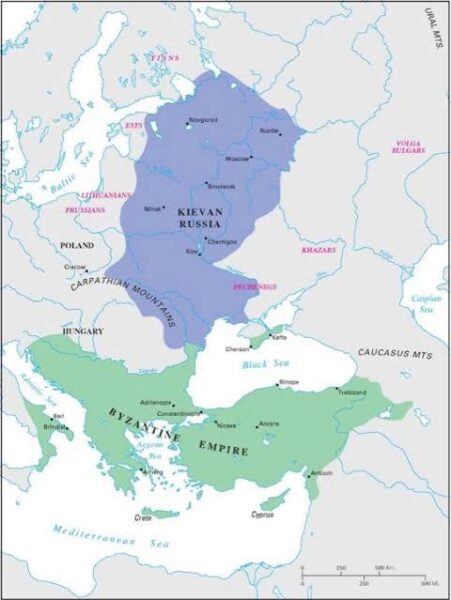
Thus, there seems at least on the discursive and narrative level to be a clear connection between Putin’s loathing of the idea of “national independence,” his desire to restore “the Russian Empire,” and his preoccupation with Russian history as rooted in the Kievan Rus’ Empire.
From about 880–1100 a group of Nordic Vikings ruled over a huge territory that stretched from the Black Sea to the tundra in the north and across the Pontic steppe to the German forests in the west. Although this empire waxed and waned, it ruled the territory until 1240 when the Mongols sacked Kyev. Only with the Mongols’ final defeat by the Russians in 1480 did the center of gravity finally move eastward to Moscow. Apparently, it is this Viking empire that Putin has feared might re-emerge as a strong economic center. One, which perhaps even in the long run draw Belarus into its orbit, further reducing Russia to an even more insignificant periphery – a nation among other nations, leaving the global scene to USA, China and India.
To put it simply: Just as Ivan the Terrible and Peter the Great had ambitions of being almighty Czars, the same applies to Putin. In this game he has of course received financial support from the oligarchs, who early on understood how to seize the Soviet Union’s massive natural resources, including the vast gas deposits. Lately, there was presumably a growing concern among these power brokers that Europe was moving toward a sustainable transition to more CO₂-neutral energy production, energizing the plans for “more control”. And following this, the war on Ukraine.
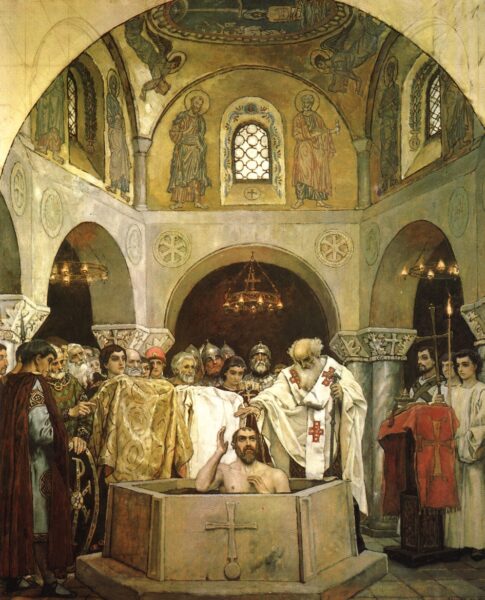
Given these economic interests, it is nevertheless significant that throughout the lead-up to the war in 2014 and the massive escalation of hostilities after 2022, Putin has consistently advanced “cultural,” “historical,” and “religious” rather than economic reasons for the war’s necessity.
Thus, Putin has also found support in the Russian Orthodox Church and its ambitions to once again control the Ukrainian church, which achieved independence in 2019 as a result of the schism between the leadership of the Russian church and the Ecumenical Patriarch in Constantinople. It is probably another reason why Putin could be quoted by the New York Times as having stipulated that supremacy over the Ukrainian church must again lie in Moscow.
These historical and cultural narratives have from the very beginning been intertwined and fairly unambiguous. The story is that Ukraine had adopted the West’s decadent culture and was heading toward membership in the EU (and perhaps NATO). Since Ukraine, however, had historically always been the starting point for Russia and therefore a natural part of the Russian Empire, this was an intolerable situation for an imperialist like Putin. In his view, Ukraine could not, historically speaking, continue as an independent nation.
It is clear that in Putin’s eyes only empires should exist – that is, centralized spheres of power – and not nations. Which, incidentally, is a perspective he shares with Trump, who also regards nations – for example Canada and Greenland – as political perversions.
But the explanation is not only cultural and historical. It is also economic, in that we are observing here a former centre’s attempt to recapture its previous identity as an empire.
In other words: an entirely necessary insight from what in the social sciences is called “World System History” seems crucial to understanding what is happening.
Within this framework of understanding, Ukraine must be characterised as a former periphery that managed to stage a revolt against the former weakened centre’s economic exploitation. Culturally, Ukraine then escaped by reinventing itself as a cosmopolitan Western country complete with southern-style cafés, its own church, its own language, and a magnificent nature. In an increasingly tense militarized environment in Moscow and its surroundings, the newly established periphery – the nation-state Russia – then prepared to subjugate the former periphery in order, at the same time, to re-establish the Russian Empire as culturally superior and thereby (also) position itself as an economic power.
That Putin in this perspective has drawn heavily on the neo-medieval narrative of Russia’s cultural, popular, and economic superiority is no surprise. But in reality it is banal: it is about strong feelings of powerlessness and the dream of regaining power; and envisioning it as an empire.
It amounts to an almost medieval approach to the future world order of the 21st century.
Karen Schousboe
World System History. The Social Science of Long-Term Change.
Ed. by Robert A. Denemark, Jonathan Friedman, Barry K. Gills, and George Modelski.
Routledge 2008.
Coercion, Capital, and European States, AD 990–1900:
By C. Tilly
Blackwell 1990

In 775, Charlemagne dispatched an army into Saxony, part of which ended in the battle at Braunsberg on the brinks of Weser in 775. Exhibition tells the story of the Saxon Wars from a local perspective

Natural disasters in the Middle Ages were met with resilience in a number of different ways: migration, rebuilding, re-settlements.
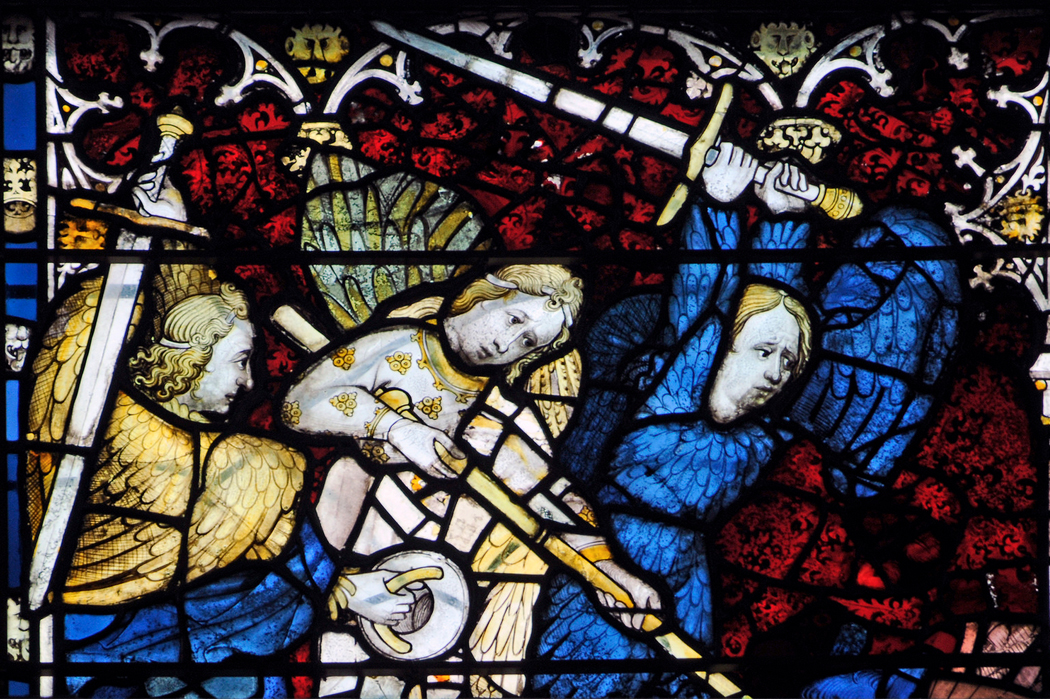
York Apocalypse panel back in Minster after restoration

Apocalyptic thinking was a common topic in Late Antiquity, reaching into the early Reformation. The following lists recent books outlining the history behind the topic and its different forms of artistic renditions.
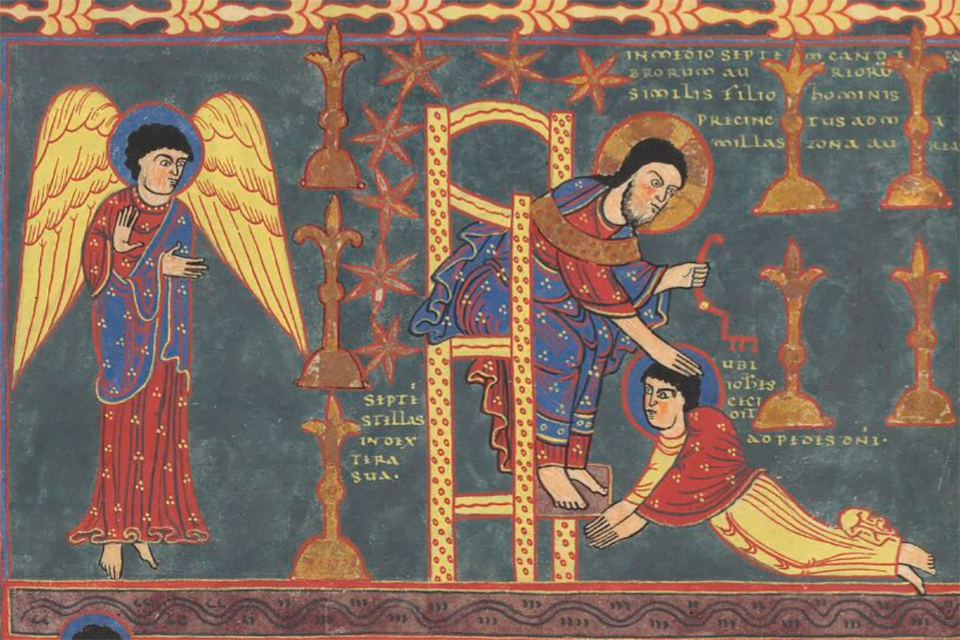
In the late 8th century, Beatus from Southern Spain found refuge in the Picos de Europa at one of the royal outposts in the fragile Asturian kingdom. He is famous for his artistic legacy, the Beatus' Apcalypses.
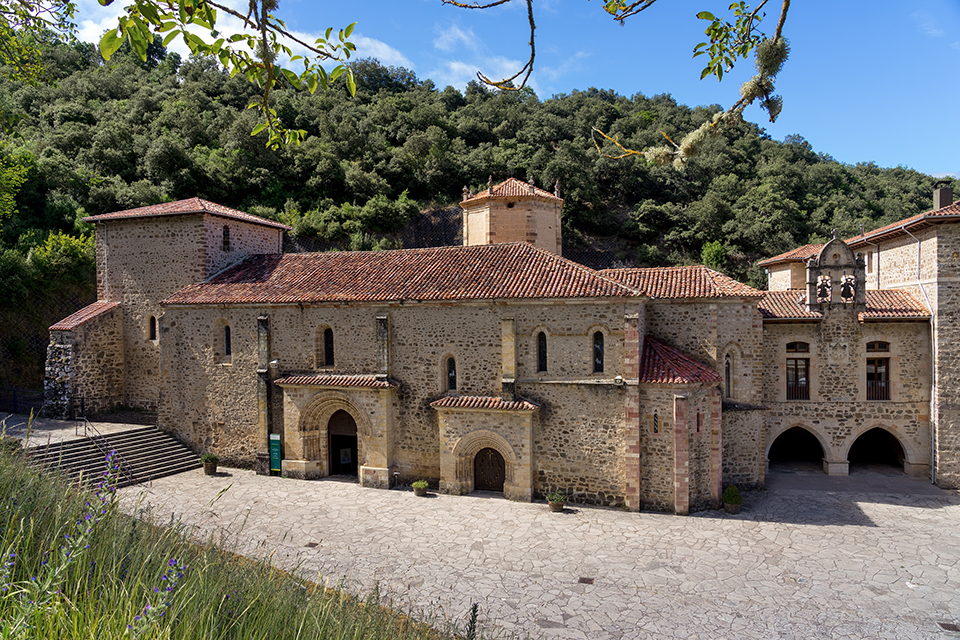
The monastery of Santo Toribio de Liébana, dating back to the 6th century, stands as one of the most significant religious sites in Northern Spain, nestled within the dramatic landscape of the Picos de Europa mountains.
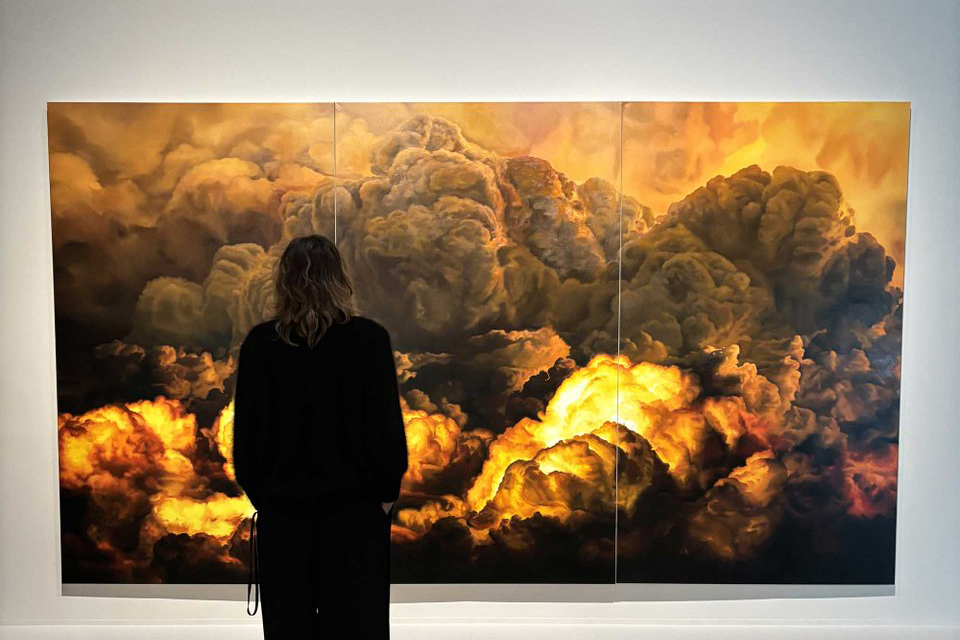
New exhibition in Paris at the Bibliotheque Nationale Française enlightens us about the history of our apocalyptic thinking in the past and present