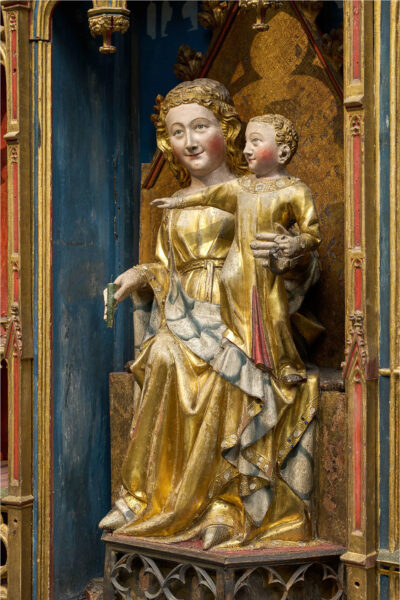
 Altenberg Madonna Enters the Städel Museum: A Landmark Acquisition
This morning, the Städel Museum announced what can rightly be described as a watershed moment for the study and appreciation of medieval art in Germany: the acquisition of the Madonna and Child Enthroned, known as the Altenberg Madonna. Dating from around 1320–1330, the sculpture entered the museum’s collection through the joint support of the Ernst von Siemens Art Foundation, the Städelscher Museums-Verein, and the Kulturstiftung der Länder.
With the acquisition of the Altenberg Madonna—made possible through the generous support of leading German cultural foundations—the Städel Museum in Frankfurt achieves the long-awaited reunification of the Altenberg Altar. This exceptional 14th-century Gothic sculpture thus ranks among the most significant acquisitions in the museum’s history.
Considered one of the supreme masterpieces of German Gothic sculpture and among the earliest surviving works of 14th-century Cologne production, the Altenberg Madonna is listed as cultural property of national importance and is therefore subject to strict export protection.
A Long-Awaited Reunion
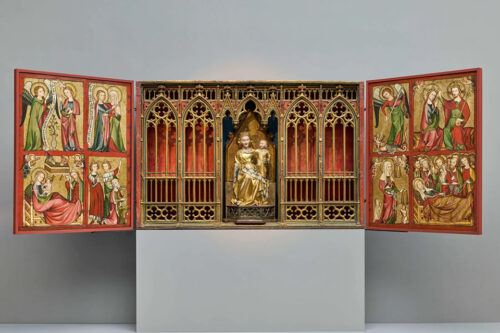 The sculpture was originally created for the Altenberg Altar, commissioned for the abbey church of the Premonstratensian convent of Altenberg an der Lahn, near Wetzlar in Hesse. For more than a century, the Städel Museum has preserved the painted wings of this extraordinary polyptych—among the oldest examples of German panel painting in its collection. The altar’s central shrine has long been held on permanent loan from the Braunfels Castle Museum. With the acquisition of the Madonna, once positioned at the very heart of the ensemble, the Altenberg Altar can now be fully reassembled and permanently presented to the public for the first time in its history.
The sculpture’s recent history reflects a prolonged period in private ownership. From the late 1920s onward, the Altenberg Madonna was located in southern Germany and, from 1981, remained on permanent loan to the Bayerisches Nationalmuseum in Munich. Its transfer to the Städel thus represents not only a major enrichment of the museum’s collection, but also a symbolic and historical return of the work to its original artistic and narrative context.
Philipp Demandt, Director of the Städel Museum, remarked: “After one hundred years, the celebrated Altenberg Madonna has returned to its rightful place at the heart of the altar—a truly memorable moment in the history of the Städel. This exceptional acquisition was made possible by the foresight of the owners and the extraordinary commitment of our supporters. I extend my sincere thanks to the Ernst von Siemens Art Foundation, the board and members of our supporting association, and the Kulturstiftung der Länder.”
The Altenberg Altar in Context
The Altenberg Altar occupies a distinguished place in the history of European sacred art. From the late 13th century onward, sculpted and painted altarpieces became central fixtures in churches across Latin Europe, fostering close collaboration between painters and sculptors. Particularly north of the Alps, altars with movable wings were developed to accommodate changing liturgical requirements throughout the church calendar. Created around 1330, the Altenberg Altar is among the earliest surviving examples of this innovative format.
On weekdays, the altar displayed scenes from the Passion of Christ against a dark ground. Gradual opening revealed the central shrine containing the Altenberg Madonna, surrounded by the abbey’s relics. On Sundays, a partial opening presented the Virgin flanked by episodes from her life. This sophisticated iconographic program emphasized Mary’s role as patroness of both church and convent, reflecting the significance of Marian devotion in the spiritual and political life of the region.
The abbey of Altenberg maintained close ties to the ruling family of the landgraves of Hesse and Thuringia. After the death of Ludwig IV of Thuringia, Saint Elizabeth of Thuringia entrusted her youngest daughter, Gertrude, to the abbey. Gertrude later became abbess and shaped its fortunes for decades, while the presence of Saint Elizabeth’s relics established Altenberg—alongside Marburg—as a major center of her veneration.
Artistic Excellence and Preservation
Artistically, the Altenberg Madonna belongs to the well-known type of enthroned Virgins with the standing Christ Child, developed in Cologne under strong French influence. Related examples are preserved in numerous collections, including the Liebieghaus Skulpturensammlung in Frankfurt. The Altenberg Madonna, however, is distinguished by its extraordinary sculptural refinement and the exceptional preservation of its original polychromy—an exceedingly rare survival for wooden sculpture of this period.
Mary is shown as a youthful figure with a gentle, animated smile, seated on a throne with a slender cushion and a high back crowned by a pointed, ornamental gable. Her feet rest upon a polygonal base adorned with tracery. In her right hand she once held a lily, symbol of her virginity and emblem of her queenship, while her left supports the Christ Child, who stands partly on her thigh and partly on the throne. The Child’s gesture—reaching toward the lost lily while clutching a bird that pecks painfully at his finger—subtly prefigures the Passion.
The sculpture’s splendor is further enhanced by the gilded garments of both figures, enriched with glass insets imitating precious stones, and by the original presence of a crown. Mary’s gold mantle, lined with ermine, underscores her role as Queen of Heaven, while the lavishly decorated throne affirms the sacred and regal character of the image.
Monastic Culture and Provenance
The Altenberg Madonna and its altar also stand as eloquent testimony to the artistic and spiritual achievements of medieval female monastic culture. Within a society dominated by male hierarchies, the Premonstratensian nuns of Altenberg fostered a remarkably sophisticated theological and artistic environment, giving rise to one of the most distinguished sacred ensembles of its time.
The sculpture’s provenance is comprehensively documented. Following the secularization of the abbey in 1803, the Madonna passed into the possession of the princes of Solms-Braunfels and was sold in 1916 to Munich art dealer A. S. Drey. By the late 1920s, it entered the collection of Julius Böhler, remaining in family ownership until its acquisition by the Städel Museum.
Martin Hoernes, Secretary General of the Ernst von Siemens Art Foundation, commented: “The Altenberg Madonna is a captivating and remarkably early example of Cologne’s medieval sculpture. Preserving cultural heritage for present and future generations lies at the heart of our mission. Bringing this work—from Cologne via Altenberg to Frankfurt—to the Städel Museum fulfills our founder Ernst von Siemens’s conviction that works of art should be placed where they can be experienced by the widest possible audience.”
PHOTOS:
The Altenberg Madonna © Städel Museum and Norbert Miguletz
SOURCE:
PRESS RELEASE: Altenberg Madonna acquired for the Städel
READ ALSO: